Locations
Resource Links



Earning a minor in biology can serve as a useful counterbalance to your major area of study. It will broaden your knowledge and learning experiences in the sciences.
Having science knowledge is helpful if you want to work for scientific, technology, healthcare, medical, or environmental companies. It is also helpful if you want to teach science, biology, health, or other subjects in a K-6 school setting.
Pairing a minor in biology with a major in business, communication, marketing, psychology, political science, public health, or sociology has the potential to make you a more attractive candidate for life science, government, social services, and other positions. It may also be useful in completing pre-requisite requirements for applying to graduate or professional programs.
Degree requirements to earn a minor in Biology at Marian include completing 20 credits in Biology at or above the 200 level. Students may apply up to three credits of internship or research coursework to that total.
Contemporary society needs classically educated citizens who understand the foundations of Western civilizations and cultures.
A minor in classical studies will provide you with a broad base of interdisciplinary knowledge about the bedrock of Western civilizations. The study of classical languages, art, history, philosophy, and mythology helps students develop analytical, critical thinking, and communication skills. Students with a minor in classical studies cultivate cross-cultural agility as they practice orienteering through the varied symbolic universes of the classical world.
To earn a classical studies minor, you will complete 18 credits from any of the following courses:
Students with a minor in classical studies have the distinction of not having completed university as a trade school for a profession, but have received an education in the liberal arts that allows them to have a more expansive worldview and philosophical understanding of society. This foundation gives them a much broader vista so that they can situate and evaluate new ideas in the context of Western civilization and cultures. For more insight into the value of classical studies, see "12 Reasons to Study Classics in the 21st Century".
Email Dr. Julia Baumgardt (jbaumgardt@marian.edu) or Mrs. Rebecca Reneau (rreneau@marian.edu) for more information.
Explore the legal and justice systems from different perspectives. Learn what leads to crime, how law enforcement and policy affect society, and what it takes to ensure fairness and justice for all. This minor is a strong compliment to social sciences, pre-law, or public policy majors.
According to a 2017 report by the Prison Policy Initiative, the American criminal justice system holds 2.3 million people in more than 3,100 local jails, 1,700 state prisons, 900 juvenile correction facilities, and 102 federal prisons. Those numbers don't include prisons in U.S. territories, immigration detention facilities, military prisons, or jails on Native American property.
Earning a minor in criminal justice will increase your knowledge and understanding of social and criminal issues that negatively impact families and communities. It will also enable you to explore best practices for solving these problems. Marian University criminal justice courses focus on understanding criminal behavior, criminal justice systems, mechanisms of social control, and their relationship to society. As a student who minors in criminal justice, you will:
To earn this minor, you'll complete 18 credits of courses selected from criminal justice and sociology. Coursework focuses on three subsystems within the field: law enforcement, rehabilitation, and social inequalities.
With just one required three-credit course (CRJ 270: Introduction to Criminal Justice), you will have maximum flexibility to collaborate with your academic advisor and select 12 credits from courses that explore subjects like:
In addition, you'll complete at least three credits choosing from course topics such as:
You will also complete a required internship to gain first-hand experience and insight into how criminal justice agencies operate. Upon graduation, you will be prepared for a general, entry-level career in the criminal justice field or entry into law school or other graduate programs.
Depending on your career goals and objectives, a minor in criminal justice is versatile and complements a range of bachelor's degree programs. You may choose to pursue employment working in law enforcement, government agencies, forensics, the legal system, or the corporate world.
| B.A. or B.S. | Minor | Possible career paths |
| Accounting | Criminal justice | Forensic CPA for the FBI or other federal agency |
| Biology | Criminal justice | Crime lab manager |
| Communication | Criminal justice | Probation, parole, or corrections officer |
| English | Criminal justice | Journalist, reporter, blogger, or writer about social issues |
| Nursing | Criminal justice | Forensic nurse |
| Political science | Criminal justice | Police officer, detective, or ATF special agent |
| Psychologist | Criminal justice | Criminal psychologist or crime scene investigator |
| Sociology | Criminal justice | Research specialist for Bureau of Justice Statistics |
| Spanish | Criminal justice | Border patrol or law enforcement officer |
Job outlooks and salaries depend on demand in the employment market, but here are some statistics collected by the U.S. Department of Labor's Bureau of Labor Statistics.
| Occupation | Growth through 2026 | Median salary (2016) |
| Criminal justice educators | 3.5 percent | $67,040 |
| Probation officer | 6 percent | $50,160 |
| Police officers and detectives | 7 percent | $61,600 |
| Lawyers | 9 percent | $118,160 |
| Psychologist | 14 percent | $75,230 |
| Social and community service managers | 16 percent | $64,680 |
| Forensic science technicians | 17 percent | $56,750 |
No matter what bachelor's degree you decide to pursue in college, having the skills that come from earning a minor in English can be extremely valuable.
Studying American and English literature will provide you with exceptional insight into the human condition, including what drives human behavior. You'll learn to better understand and appreciate the people around you, including colleagues and customers after graduation. More importantly, you'll learn how to apply the insights you gain about people to build the strong communication, audience analysis, and critical thinking skills that today's employers value, especially in a fast-paced, ever-evolving digital world.
If you plan to major in a science, math, engineering, or technology-oriented field, adding the educational depth that comes from studying English to your coursework is a great choice.
Why? According to a TIME.com article, a "well-chosen minor is one that adds evidence of a skill that can be applied to your major but isn't necessarily contained within it." In other words, to boost your career options and stand out from other job applicants in competitive employment fields, it helps to choose a minor that balances and complements your overall degree.
Students pursuing other majors—such as marketing, management, graphic design, political science, public health, nutrition and fitness, and many other fields—can equally benefit from a minor in English. Education majors who want to pursue licensure to teach English in K-12 schools or adult education settings also choose the English minor.
To earn this 18-credit minor, you can choose from any ENG courses except 101 and 115. You'll complete at least six credits of 300- and/or 400-level courses.
You will study a range of historical periods and genres of literature and issues in literary criticism and contemporary theory. You'll explore the ways that the English language shapes, imagines, and reflects current and historical cultural norms. Along the way, you can also strengthen and sharpen your writing skills.
Examples of courses you might complete include:
For those who are planning careers in math, science, engineering, or technology settings, being able to produce technical writings, grant proposals, research articles, or corporate blog posts on the latest industry trends or news can make you a valuable member of your employer's team.
No matter what your interests and career goals are, by strategically pairing an English minor with a complementary major in another field you can pursue a range of interesting, relevant careers.
Here are some professional careers with anticipated job growth and average salary statistics as tracked by the U.S. Department of Labor's Bureau of Labor Statistics.
English as a second language (ESL) teachers help culturally and linguistically diverse groups of students become fluent in English to overcome language barriers and master grade-level curriculum.
If you believe children need good English skills to succeed in American classrooms—and to become more fully engaged residents of their local communities—pairing this minor with one of our undergraduate degrees in education from Marian University is a good career choice. You can choose from a B.A. in applied educational studies, elementary education, secondary education, special education, or health and physical education.
While most students at Marian who pursue this minor want to be classroom teachers (whether in the U.S. or overseas), this minor may also be appropriate for students who want to work in business, social service, church, and other settings.
According to a 2017 report by the Indiana Department of Education's Office of English Learning & Migrant Education, more than 112,000 Hoosier children speak a language other than English in their homes. In fact, there are more than 275 different languages spoken by students who attend Indiana K-12 schools.
The American Immigration Council reports that Indiana has a growing immigrant community, of which many members were born in Mexico. Other top countries of origin are India, China, the Philippines, and Myanmar.
Anticipating this demographic trend, Marian University's ESL program prepares you to be a responsive, culturally competent instructor who can effectively teach English language learners in inclusive environments.
Marian's ESL courses will help you build a stronger command of the English language, including its historical roots, grammar, semantics, and dialects. You'll explore how students acquire an understanding of language, process the language they read and hear, and employ language in social settings.
In addition, you will study the process and stages of second language acquisition and the learning capabilities of students at each stage. The roles of culture and acculturation in language acquisition and classroom performance serve as a catalyst to examine teaching strategies, lesson, and assessment modification. You'll gain understanding of current approaches to teaching language, contexts for language learning, and the types of materials that aid in teaching and learning.
In total, you will complete at least 21 credits of ESL coursework, including courses such as:
When combined with one of our education degrees, you will be prepared to pursue initial teaching licensure in the State of Indiana. With your state license, you can teach ESL in:
Depending on your career interests and goals, you might teach English outside of the United States. If you love to travel and explore life in other countries, teaching English overseas is an option.
Because the ability to teach and the ability to speak more than one language are valuable commodities in the business world, earning an ESL minor can open doors beyond the classroom. You might work for employers such as:
According to the U.S. Department of Labor's Bureau of Labor Statistics (BLS), here are some career paths with projected growth and salary data.
Earning a minor in environmental biology provides students with a strong foundation in ecology, conservation, and biodiversity. This minor is an excellent complement to any major, helping students to be stewards of the natural world.
A defining feature of the program is the Nina Mason Pulliam Ecolab, a 75-acre living laboratory where students can gain practical experience through field courses, ecological restoration, research and environmental monitoring.
Degree requirements to earn a minor in Environmental Biology at Marian include completing 18 credits including BIO210 and 211L and a selection of the following courses:
According to the International Organisation of La Francophonie (IOF), there are about 300 million French speakers around the world.
Earning a minor in French studies at Marian University will enable you to explore the language, literature, and culture of France and the Francophone world.
Indianapolis has a number of connections to French business and cultural organizations.
Don't lose what you learned in high school! If you want to earn a minor in French at Marian University, take the required courses during your First-Year Student and sophomore years, if possible.
To earn a minor in French at Marian, you will complete 18 credits above the 100-level determined in consultation with your academic advisor.
You'll complete courses such as:
Being fluent in French will give you more career options after graduation. It pairs very well with bachelor's degrees in fields like the arts and sciences, business, and education.
Depending on your plan of study and your career goals, earning a minor in French can be useful for:
As it relates to business, French is the second most common language for business spoken in the European Union.
If you are a business major, you may want to choose Marian's French for the professions minor rather than the French studies minor. Talk with your academic advisor about the differences between the two programs and which is the best fit for you based on your career interests and goals.
If your goal is to teach French in high school or educational settings, learn more about our Bachelor of Arts (B.A.) in Secondary Education.
If you plan to work in the sciences, business, education, or healthcare, being fluent in German is a valuable credential that can enhance your career opportunities. Our German for the professions minor will give you the language and cultural competencies you need to effectively interact with German speakers.
Wherever your career may take you, knowing German can increase your career and employment options with German- and foreign-owned companies in America and abroad.
Good bilateral relations with Germany are vital, reports the U.S. Department of State. The U.S. and German economic, political, and diplomatic relationship is key for continued prosperity and stability in both countries and around the world.
Learning German can increase your earnings. The time you invest in studying German in college can mean a salary that's nearly four percent higher, reported The Economist in 2014. Over the course of your career, that could mean nearly $130,000 in additional earnings.
In short, being fluent in and having a strong command of the German language distinguishes you from other job candidates, especially in competitive employment markets and industries like advanced manufacturing, engineering, science, healthcare, and business.
As a minor in German for the professions at Marian, you will:
Our expert faculty advisors help you develop a personal plan of study in which you pair a minor in German for the professions with a range of different majors based on your individual career interests and goals. For example, this minor pairs well with bachelor's degrees like:
We will encourage you to study abroad. Marian offers a range of short-term and semester-based study abroad programs.
We'll also help you gain global work experience using your German language skills. Through our partner program with Salzburg College, you can study abroad in beautiful Austria and complete an internship with an Austrian firm, gaining real-world global professional experience.
Required and elective courses enable you to gain knowledge of the vocabulary and professional discourse relevant in professional organizations where German is spoken.
Courses are sequenced to provide comprehensive knowledge of professional practices, tools, and experiences. Through your studies, you will gain greater insight and perspective about:
You will complete at least 18-20 credits of courses, including:
*NOTE: If you test into an advanced level of German, you will take nine (9) credits of upper-level German classes instead of GER 101 and 102.
Examples of upper-level German courses from which you can choose:
This minor will benefit you in any professional position where German language and cross-cultural skills are important. German for the professions is a good choice for:
In addition, there are paid post-graduation opportunities in Germany, Austria and Switzerland for students of German. These include:
Thinking of grad school? It is FREE at public universities in Germany, even for American and other international students. Learn more at studying-in-germany.org.
Considered one of the world's major languages, German is the first language of about 95 million people around the world. It's the most widely spoken native language of those who live and do business in the European Union. About 110 million people speak German as a second language.
Some of the world's top artists and scientists speak German. Some of the greatest scientific discoveries in the 20th century were made by Germans. Scientists from German-speaking countries have won dozens of Nobel Prizes in physics, chemistry, and medicine. About one-fifth of the world's new books (and one-tenth of all e-books) are originally published in German.
In both business and social settings, earning a minor in German studies will enable you to better understand one of the world's most important languages.
This minor is an excellent choice for careers in business, engineering, finance, law, public service, religion and the ministry, international relations, philosophy, healthcare, the sciences, and the arts.
Fluency in German will enable you to diversify your career options after graduation, no matter what bachelor's degree program you choose.
To earn a minor in German studies at Marian, you'll complete 18 hours of courses above the 100 level determined in consultation with your advisor. Together, you'll choose from courses like:
Whether you want to work internationally or here in the U.S., you'll be an attractive job candidate for employers who want to build relationships in German markets or among German customers, clients, and stakeholders.
Some of the career paths you might choose include:
If you enjoy math but want to have more academic and career flexibility, consider adding a math minor to your plan of study. Earning a minor in math is a good way to strengthen your skills and knowledge of mathematical theories and concepts without the in-depth learning that earning a B.S. in math requires.
A mathematics minor can be developed to complement any major, but is especially useful if you are majoring in one of the sciences or want to apply to a graduate degree in science or technology after completing your undergraduate studies.
If your career goal includes working in a science or technical field, earning a minor in math can be a smart choice because it complements courses in biology, chemistry, physics, clinical laboratory science, engineering, and other subjects.
It's also a good choice for students who want to work in business and corporate settings like accounting, finance, business analytics, management, and marketing, among others.
To earn a minor in math, you will choose from required and elective courses like:
Earning a minor in math that complements your degree program can make you more attractive as a job candidate in a variety of fields and organizations, especially those related to:
Talk to one of our academic advisors about whether earning a minor in math is right for you.
If you have an interest in the performing arts, consider adding a minor in music to your plan of study.
Whether your passion is performing under the bright lights on the main stage or you are looking for more knowledge about music and the performing arts, a music minor will enhance your career preparation and enrich your major.
Earning a music minor enables you to use your creative talents and energies—and gain important skills useful for careers in business, communication, education, history, theatre, studio art, psychology, and many other fields.
The Peace and Justice Studies interdisciplinary minor is open to students in any major at Marian University. Pair it with your major to deepen your understanding of social justice, activism, and peaceful conflict resolution. This program is designed to give you tools to analyze and challenge injustice, build skills in argumentation and dialogue, and turn your values into action. You will create and present your work in a portfolio, engage in open dialogue, and reflect on how Franciscan values guide your actions. You can also participate in intentional learning communities, such as the Dorothy Day House (for women) and Peter Maurin House (for men), where you live and learn with peers who share your passion for service and justice.
Help make the world a better place! As a minor in peace and justice studies, you'll explore the origins, histories, concepts, theories, and ethical debates surrounding inequality and injustice.
Develop and deepen your understanding of and empathy for individuals and groups of individuals who have been hurt by inequality and injustice. Explore current social initiatives, public policies, and efforts to promote peace, equality, and justice.
Expect a rigorous academic experience in the classroom and a dynamic interpersonal experience outside of the classroom. You will:
You may also choose to participate in a special residential learning community. You'll live with like-minded peers who want to practice the Franciscan values upon which Marian University was founded in their daily lives.
To earn a minor in peace and justice studies, you'll complete at least 18 credits of sociology, political science, communication, environmental, philosophy, and theology courses.
With just two required three-credit courses (POL 155: Introduction to Peace Studies and SOC 145: Introduction to Social Justice), you'll have a great deal of flexibility to tailor your studies according to your interests and career goals. These are just a few of the course topics from which you might choose:
For a comprehensive list of courses from which you can choose, please review our undergraduate course catalog.
When you've finished your courses, you will be able to demonstrate your:
Upon completing required and elective coursework, you'll have a deep understanding about the need for socially conscious leadership and how you can promote peace and justice as part of your life's work.
This minor complements a range of bachelor's degree programs, including:
Among the career paths that you might choose:
You'll also have a sound professional and ethical foundation for advanced study in graduate programs, including law, public policy, environmental affairs, and the social sciences.
At Marian University, bachelor's degree students majoring in non-health related fields can add an academic minor in public health to their plans of study.
Whether you major in business, biology, or any other field, earning a minor in public health can be a smart choice.
Our minor in public health provides you with broad knowledge of public health principles and applications to develop an appreciation of health and disease prevention at the population level.
Earning a minor in this field will help you discern connections between public health and other fields. It will also help you understand the basic analytic approaches to applying these connections in the workplace. What you learn from the public health minor, in other words, will add depth that informs and shapes your viewpoint of the field in which you major.
Students who minor in public health are interested in careers requiring innovative, multidisciplinary approaches for solving public health challenges, like tracking the spread of chronic and communicable diseases, providing needed community health education, or monitoring health problems in newborns.
An undergraduate minor in public health can help launch a variety of careers requiring a broad, general knowledge of public health theories, issues, and concepts. Adding a public health minor to your bachelor's degree studies can prepare you for entry-level positions in public health careers as well as advanced studies in graduate programs.
This minor can be an asset for students who want to pursue careers such as:
Note that many careers in epidemiology, law, and other fields require advanced studies at the master's and/or doctoral levels. The first step to pursuing careers in these fields, however, is to earn a bachelor's degree.
Choose a minor that is specifically designed to help you succeed professionally. Broaden your career horizons through courses on the Spanish language and Hispanic cultures for students who are majoring in business, education, health professions, social work, and ministry.
Build the language proficiency and cultural competency you will need to effectively communicate and engage with Spanish-speaking communities, including clients, colleagues, students, and patients. Take advantage of exciting internship opportunities, both at home and abroad.
If you want to work in corporate settings, teach in a school classroom, or work with patients in healthcare where Spanish is a primary language, Marian's Spanish for the Professions minor is an excellent addition to your career.
Gain cross-cultural communication skills related to your chosen profession and develop a global perspective and understanding that employers value.
As a Spanish for the professions minor, you will complete at least 18 credits of courses, including SPA 310 Written Communication or SPA 311 Written Communication for Heritage Speakers and two of the following:
Intended for students who want to work in the healthcare field, these courses are appropriate for students who are majoring in biology or chemistry and completing one of our pre-professional healthcare programs. They are also appropriate for students majoring in fields like clinical laboratory science, exercise science, health and physical education, nursing, nutrition, fitness, and wellness, physiology of exercise, psychology, public health, sports performance, and social work.
Intended for students who plan to work in large and small business settings including the corporate and nonprofit worlds, these courses are appropriate for accounting, business analytics, communication, finance, marketing, management, and related majors.
We also recommend you study abroad in a Spanish-speaking country. Credits earned through short-term and semester-based experiences may count toward this minor. Talk with your academic advisor for more information.
Review our undergraduate course catalog for complete details about academic requirements.
Many of our minors want to work in Education and ministry, where they can use their linguistic and cultural competency to make meaningful connections with students, parishioners, and families.
Having effective Spanish language skills appropriate for professional settings will provide you with more job opportunities and help you distinguish yourself as a desirable employment candidate.
Examples of career paths you might choose include:
Talk with us about how this minor fits in with your career goals and interests by emailing Dr. Julia Baumgardt at jbaumgardt@marian.edu.
With more than 485 million speakers, Spanish is the primary language of South, Central, and Caribbean countries. It's also widely spoken by a growing population of people living in the United States.
Gain knowledge, language proficiency, cultural competency, and new perspectives about the cultures, heritage, and histories of Spanish-speaking peoples. Get the skills and experience you need to communicate with Spanish speakers, both at home and abroad.
Engaging with Spanish-speaking communities and cultures will broaden your perspective and set you up for success in nearly any field.
In fact, labor and employment experts report median salaries for employees who speak more than one language are five to 20 percent higher than the salaries of those who speak just one language.
Our expert faculty will challenge and encourage you with their native and near-native Spanish language competence. Thanks to small class sizes, you'll get one-on-one faculty attention and mentoring.
To earn a Spanish studies minor, you will complete at least 18 credits of Spanish courses, including:
You'll also complete 15 credits of Spanish electives. You can choose from courses like:
For complete course descriptions, please review our undergraduate course catalog.
A minor in Spanish studies is an excellent complement to any course of study. With this minor, you can:
In addition, you'll be encouraged to study-abroad in a Spanish-speaking country. We offer both short-term study abroad courses and semester-based programs that can include internships. Marian also has foreign exchange programs with universities in Spain and other countries. Talk with your academic advisor about study-abroad options
Talk with us about how this minor fits in with your career goals and interests by emailing Dr. Wendy Westphal at wwestphal@marian.edu.
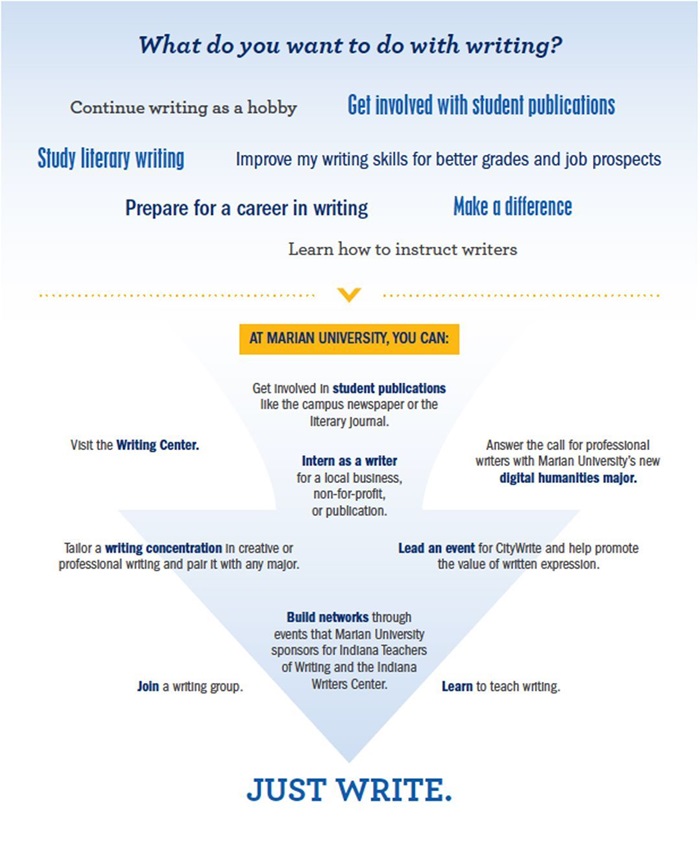
The Writing Minor at Marian University invites you to tailor writing experiences—in and out of the classroom—to your goals and interests. You can customize your path based on your professional aspirations:
To earn the minor in writing, you will complete 18 credits. This includes a core requirement of ENG 302, 303, and 322.
The remaining credits are chosen from: ENG L20/30/40, 109, 204, 208, 209, 210, 255, 309, 367, 370 or 470, 360/460 (approved as writing internship), COM 225, COM 324, COM 326, COM/ENG 239, COM/ENG 367, and/or other department-approved writing courses. Note: A writing-intensive course in your major area of study counts toward the writing minor.
Students may also elect to complete a minor in Philosophy. If you choose to minor in Philosophy, you need to complete six philosophy courses. The minor aims to give students the freedom to pursue their own philosophical interests, while ensuring breadth of knowledge of either the history of philosophy or contemporary philosophy. The philosophy faculty would work with you to select courses that complement your major, and allow you to reflect on the presuppositions of your major from a philosophical perspective.
The Philosophy Department also offers the Ethics Specialization. The Specialization in Ethics aims to provide you with
The Philosophy Department serves the Minor in Civic Leadership and Capitalism. This interdisciplinary program combines coursework in Business, Communication, History, and Philosophy to form ethical civic leaders interested in a wide array of future careers. You can learn more about the minor, and the associated Fortune Institute and Fortune Scholars Program by clicking here.
Did you know that Marian University has a pre-law program? Philosophy is among the top three majors completed by students interested in pursuing law school. For more information in the St. Ives Pre-Law Program, click here.
18 credits including THL 105; one course from THL 232, 307, 308, 332, 336, 337; one course from THL 226, 228; one course from THL 218, 219, 316, 319, 321, 322, 338; one course from THL 405, 423, 428, 472, 474; one additional 3-credit THL course at the 300-400 level (excluding mentoring and internships).
Ministry Studies Major (30 credits)
The Ministry Studies major is distinguished from the theology major with an emphasis on applied ministry. It’s intended especially for anyone who would pursue a calling—along with Saints Francis and Clare—for rebuilding the church. With only 30 required credits, this major is our most streamlined option for students who would double-major in almost any other academic program and is particularly suited for San Damiano Scholars.
Ministry Studies Required Core (27 credits)
Pastoral Electives (any 3 credits)
Morality Electives (any 3 credits)
Social Justice Electives (any 3 credits)
Systematic Electives (any 3 credits)
Ministry Studies Minor (minimum requirement for San Damiano Scholars)
21 credits including THL 105 and 270; 170 or 272; three credits from THL 361, 371, 472, or 474 [NSG majors may substitute 427 and 435, or 478]; three credits from THL 226 or 228; three credits from THL 316, 318, 319, 321, 322, or 423; and three credits from THL 307, 308, 336, 337, or 405.