
A Knockout Summer Research Experience at Rock Steady Boxing
A Knockout Summer Research Experience at Rock Steady Boxing
By: |
Published: November 17, 2026
| Categories:
Healthcare
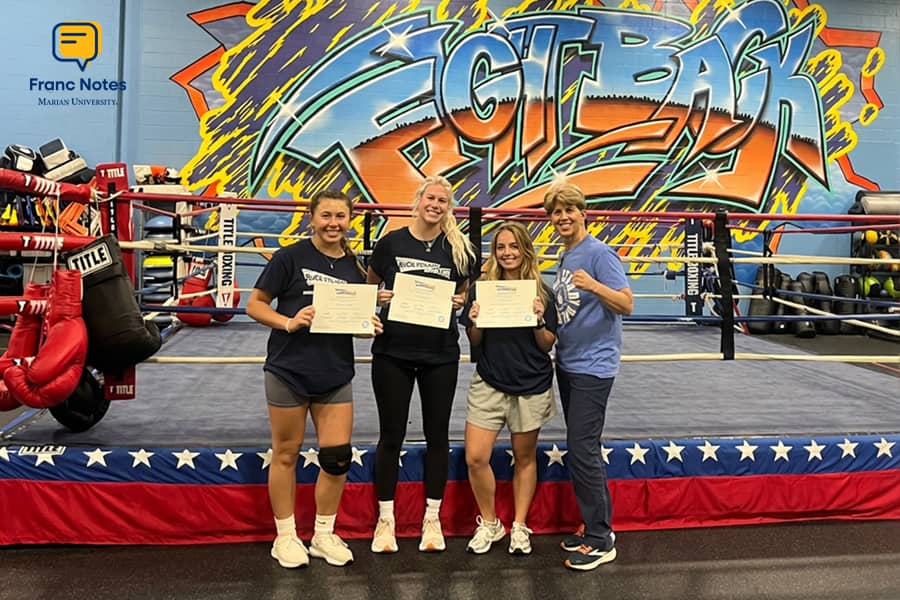
Rock Steady Boxing (RSB) is a specialized, boxing-based fitness program designed for individuals diagnosed with Parkinson’s disease that started in Indianapolis, Indiana. The program aims to help participants “fight back” against the functional limitations associated with Parkinson’s disease through targeted exercise interventions. These interventions focus on improving quality of life by addressing motor and non-motor symptoms, promoting functional independence, and fostering a supportive community environment that encourages social engagement and sustained participation. RSB provides an encouraging community and social support network that traditional medicine alone could not.
Maintaining the Rock Steady Boxing Experience
As RSB gained traction from many boxer success stories, their affiliate numbers rose to over 800 locations worldwide. While this is a positive development in the Parkinson’s community, RSB was challenged to ensure all boxers receive the same experience, no matter the affiliate coach or location. To assess the delivery and adherence to the RSB brand and methodology, Miriam Rafferty, PT, DPT, PhD, with the Shirley AbilityLab in Chicago, Illinois, and Stephanie Miller, PT, PhD, developed the FISTool (Fidelity, Implementation, and Safety) that outlines and measures the key components of the RSB method.
Our Paths to Rock Steady Boxing Research
 Aside from being a Marian University faculty member and founding director of their Department of Physical Therapy, Dr. Miller has conducted 10 studies with RSB over the last 18 years. The three of us, current osteopathic medical students (OMS), Claire Litmer, MS, OMS-2, Breeann Mild, MS, OMS-1, Olivia Bucher, OMS-2, were given the opportunity to take part in this research assessing the consistency and validity of the FISTool by applying it to different RSB affiliate locations. However, before we started data collection, we needed to understand what it really meant to be “Rock Steady Boxing.” To gain a comprehensive view of what each class entails, we went through coach training.
Although we were brought together for this coach training, we became involved in research at RSB through different pathways.
Olivia was drawn to RSB due to experience with family members living with Parkinson’s disease, as well as her six years of professional experience working in memory care and dementia units within nursing homes. A key aspect of RSB that resonated with her was its emphasis on empowering participants to take an active role in managing their health, rather than relying solely on ongoing medication adjustments and frequent medical appointments that did not significantly improve or alter disease progression.
As for Claire, she was interested in gaining research experience, but she knew she would prefer experience that was clinically focused on human subjects rather than lab work. When she was introduced to Dr. Miller and her work at RSB, she instantly knew she wanted to be involved. Fitness is an important part of her life, and getting to work with a fitness-based program for people with Parkinson’s disease aligned well with that interest.
To fulfill the curriculum in Marian’s Master’s in Biomedical Science program, Bree strove to participate in meaningful research. As a former athlete, fitness and sports are still an integrative part of her life; she is especially drawn to how exercise can be an additional part of patient treatment. RSB allowed her to be able to see real life examples of how an active lifestyle can improve both physical function and mental health.
Becoming Rock Steady Boxing Coaches
We began our quest to reach RSB coach status with about 11 hours of online training that focused on Parkinson’s disease etiology, as well as basics of boxing, how to maintain boxer safety, and how to run a RSB affiliate program. We were then ready to apply what we learned and take on the in-person coach training.
Our two days at Rock Steady headquarters, in Indianapolis, Indiana, were filled with fun, exercise, learning boxing combinations, and being taught how to use boxing equipment, including speed bags, heavy bags, and focus mitts. We were learning what it really takes to be a great coach and how to bring challenge, excitement, encouragement, and safety to workouts for the boxers. At our class, there were future coaches from all around the country eager to bring RSB to their communities. Everyone had unique backgrounds from fitness instructor to healthcare worker—all united by the desire to fight back against Parkinson's disease.
Learning From the Boxers Themselves
As a testament to the impact of RSB, one of the instructors was actually a Parkinson’s boxer at Rock Steady himself. Prior to joining RSB, he described his poor mental and physical health, as Parkinson’s challenged his ability to complete basic daily tasks. You’d have never guessed this by the smile on his face as he asked us, “Is that all you’ve got?” during 1:1 drills with the focus mitts.
The most impactful part of our training was when we were able to workout with the boxers. The boxers quickly accepted us into the group teaching us the ins and outs—what stations were the most enjoyable and games they played to add some extra fun.
The boxers were ready to show off for us. One told us how when he was diagnosed with Parkinson’s he wasn’t able to jump. He then proceeded to out jump rope both the boxers and the coaches. In another station, we executed a drill called “chase the rabbit” where we quickly side shuffled laterally around the ring—but there was a twist. The boxers took turns practicing falling to the ground and rolling to get back up mid drill. When it was our turn, we all remember thinking “I don't know the last time I hit the ground going full speed.” The boxers in our groups were quick to assure us that it wasn’t as scary as it looked and gave us some pointers for a successful tuck and roll, although ours wasn’t as smooth as some of theirs.
Connecting RSB to Whole-Person Care
As awareness of integrative and non-pharmacologic approaches to disease management continues to grow, an increasing number of interventions are being recognized as valuable adjuncts in the treatment of chronic conditions, including Parkinson’s disease. As future physicians, it is essential to acknowledge that effective patient care and disease management extend beyond pharmacologic and surgical therapy and routine diagnostic testing. At the Marian University Tom and Julie Wood College of Osteopathic Medicine, medical education emphasizes a holistic framework that considers the interconnectedness of the mind, body, and spirit. Within this model, programs such as Rock Steady Boxing represent important complementary resources that support whole-person care.
RSB addresses physical health by improving coordination, balance, and fall prevention, while simultaneously fostering a supportive community of individuals facing similar challenges. This community-based approach promotes psychosocial well-being and encourages a more positive and empowered response to diagnosis. When we asked Dr. Miller about the impact of RSB she has seen through her work, she remarked “They [participants] also feel responsible to be there for their fellow boxers; it’s truly a community.” Ultimately, comprehensive patient care requires attention not only to physical symptoms but also to the environmental, social, and emotional factors that influence a patient’s ability to manage their health.
Integrative programs such as RSB highlight the importance of treating the patient as a whole rather than focusing solely on disease pathology. In a typical classroom setting, students see most illnesses, including Parkinson’s, as stagnant and linear clinical constructs, devoid of any human connection. While we can identify the disease itself through the lack of dopamine and its symptoms, it can be a struggle to recognize how much it can change a patient’s life. For example, people with Parkinson's often lose autonomy with daily tasks such as driving, getting up off the floor or getting out of a chair.
However, RSB’s approach gave them a reason and a way to fight back while regaining the things that did not seem possible. Through a community of people with shared experiences and an additive treatment of exercise that focuses on enhancing their autonomy with daily life skills, boxers are no longer limited to their diagnosis.
RSB’s curriculum is an excellent case of how holistic care can help patients and their providers achieve the impossible.
Related Stories

October 26, 2026
Inside St. Vincent's Transitional Year Residency Program
October 19, 2026