Locations
Resource Links



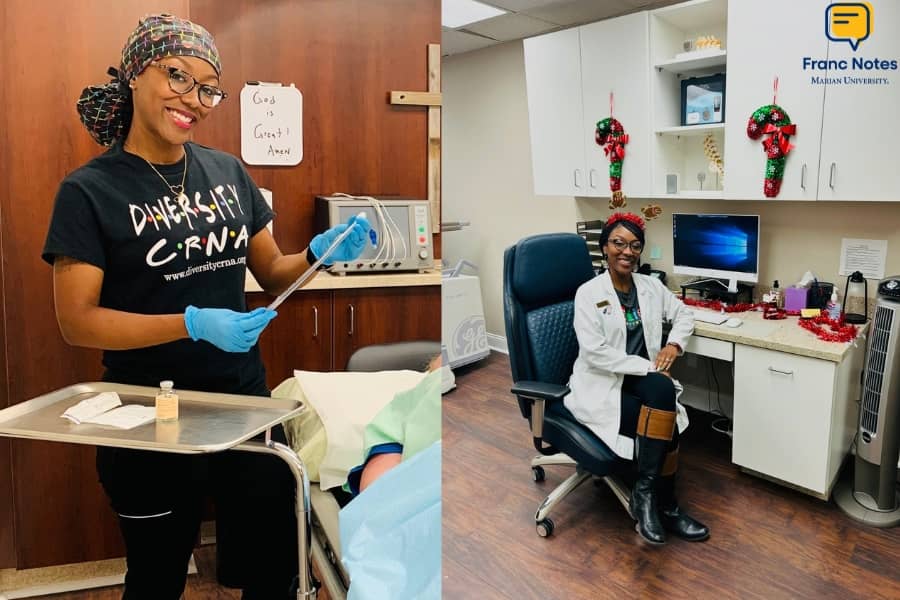
When I was offered admission to anesthesia school, as a first-year Student Registered Nurse Anesthetist (SRNA), I was filled with excitement and purpose; however, getting there wasn’t easy.
Marian University was the only Certified Registered Nurse Anesthesia (CRNA) program I applied to. It was also the closest option for me, as relocating wasn’t feasible, so I had to trust that if this door was meant for me, God would open it. I applied to anesthesia school three years in a row. The first year, I was told no. The second year, I was placed on a waiting list. The third year, I was waitlisted again, and by that point, I truly believed anesthesia school might not be a part of God’s plan for me. But then, just 19 days before the start of the program, I received the call that I was taken off the waitlist. Everything shifted in a way I didn’t fully understand at the time.
It had always been a dream of mine to pursue anesthesia school. I had always been someone who pushed myself to climb the ladder of success. When I first looked into going to anesthesia school several years ago, there were no nearby CRNA programs, so I pursued what I believed was the next best step: becoming a nurse practitioner. I had been a registered nurse since 2012 and earned my family nurse practitioner license in 2019.
At that stage in my life, I didn’t fully realize that life wasn’t just about chasing the next level of success; it’s about having the right heart posture. I wanted to pursue anesthesia school because I viewed it as the next step in my career, but I hadn’t truly examined whether my desire was rooted in purpose or just progression.
Have you ever pursued something because it seemed like the logical next step, only to realize later that you hadn't fully examined your why?
 In 2020, I left my full-time nurse practitioner position to gain Intensive Care Unit (ICU) experience as a registered nurse, since transitioning from a family nurse practitioner position directly into an ICU role wasn’t an option. I completed two years of part-time ICU work to meet all the requirements needed to apply for CRNA school. I returned to working as a nurse practitioner in a pain clinic for another two years, which was one of the best jobs I had ever had. I was financially stable, confident in my work, and had a great sense of autonomy.
When I was later accepted into anesthesia school, I found myself in a dilemma. One side of me questioned everything: Why pursue anesthesia if it meant sacrificing time with family and friends? The other side reminded me: You've always wanted this—you've already sacrificed so much.
Within that tension, I realized I had been pursuing anesthesia for the wrong reasons. I had been chasing success, not surrender. So I sought the Lord for clarity, and I received it. I wasn't being called to climb higher, but to be used for more. I stayed in anesthesia not because it was the next rung on the ladder, but because I believed God was calling me there. For me, anesthesia school was no longer about earning another title or reaching the next career milestone. It became about being obedient to where I felt God was leading me and trusting that He had a purpose for me in this profession that was greater than my own ambitions.
The Weight of Imposter Syndrome
Walking into anesthesia school, I thought, “Maybe I don’t belong here,” but that feeling didn’t come out of nowhere. Just weeks before the program started, I had already convinced myself it wasn’t happening. After being waitlisted for the third time and with the start of the program quickly approaching, I shifted my focus to my book and business. Then, unexpectedly, just 19 days before the program started, I got the call. Instead of the peace imagined, I felt overwhelmed. I was scrambling to get everything in order while trying to process what it all meant.
I had already made plans… mentally moved on, and now everything had shifted again. To be honest, my first reaction wasn't calm confidence. It was more like, "Wait... now?" as I mentally reviewed everything I suddenly needed to accomplish before classes began. Even after prayer and clarity, I entered the program mentally stretched and trying to catch up.
 I started with three courses. One was manageable, but advanced pathophysiology quickly exposed how unprepared I was. The course required a deep understanding of the material, not just memorization. I felt buried before I even began. It didn’t take long to realize that pathophysiology was going to quickly humble me. It wasn’t my first time seeing the material.
I had taken pathophysiology nearly nine years earlier, in May 2017, during my nurse practitioner program. But this time was different. My mindset wasn’t where it needed to be, and I quickly realized that prior exposure wasn’t going to save me. For my first exam, I underestimated the workload and didn’t give myself enough time. I paid the price and didn’t do well on the exam.
For the second exam, I thought I had a solid strategy. I relied heavily on practice questions, just as I had done successfully in another course, and I reached out to professors and classmates for advice. But with so many different study methods coming my way, I found myself trying multiple approaches at once without truly committing to what worked best for me. I didn’t do well on the exam. Pathophysiology was a different ball game. That’s when it became clear. I was studying questions without fully understanding what I was reading. My grade slipped, and I was in jeopardy of failing.
Switching My Strategy
At that point, I had two choices: keep repeating the same cycle or completely change my approach. For the third exam, I slowed down and focused on truly understanding the material instead of rushing through it. I used active recall, reviewed slides repeatedly, and practiced questions with intention. I also sought advice again, but this time, I applied it with discipline and consistency.
I passed the final exam, but despite that, it wasn’t enough to bring my overall grade up. I still failed the course, and that was difficult to process. During that time, I also found myself worrying about what others would think. As a nurse practitioner, I questioned how it would look to struggle in a course I had taken before. But I had to remind myself of something important: everyone’s journey is different. What matters isn’t how it looks to others, but what God is doing in and through you.
What I’m Doing Differently Now
Going through this experience forced me to rethink how I learn. After reading Make It Stick, I realized that real learning comes from effortful retrieval, not simply rereading notes or recognizing information on a page. Research suggests that actively recalling information strengthens learning and retention more effectively than passive review and that spaced retrieval improves long-term memory (Brown et al., 2014).
Now, I actively recall information instead of passively reviewing it. I use spaced repetition instead of cramming, and I challenge myself to apply what I have learned in different ways, so I truly understand it. Rather than relying on a single study method, I focus on understanding concepts, identifying knowledge gaps, and adjusting my approach when needed. As I retake pathophysiology and continue through the remainder of my anesthesia program, I plan to build on these evidence-based learning strategies and approach future exams with greater preparation, organization, and confidence than I did when I first started.
What Every Student Should Know
How Franciscan Values Shaped My Growth
Two Franciscan values helped reframe this experience for me. Responsible stewardship taught me that preparing well is part of being faithful to my calling, not just for myself, but for the patients I serve and will continue to serve. The Franciscan value of Peace and Justice reminded me to stop comparing my journey to the journey of others, give myself grace, and trust God’s timing even when things don’t go as planned.
My Setback Became a Setup for Growth
Yes, I was upset when I saw my final grade. But as I reflected, my perspective began to shift. This wasn’t the end; it was a refining moment.
If you’re in healthcare or any profession and feel overwhelmed, remember why you started. What feels like a setback may actually be preparation for what’s ahead. I’m still in anesthesia school, and now I understand that this didn’t stop me; it’s shaping me. What if the obstacle you're facing today isn't meant to stop you, but to strengthen you for the next season of your journey? Don't give up. Refocus, adjust your strategy, and trust that God is still guiding you forward.
Failure can do one of two things: it can either discourage you from moving forward, or it can refine you into the person you're meant to become. Failing forward isn't about avoiding failure or running toward it. It's about choosing to learn from it, grow through it, and use it as a stepping stone, rather than a stumbling block.
If there's one lesson I learned through this experience, it's that prior exposure doesn't replace present preparation. No amount of past experience can take the place of being mentally and physically prepared with the willingness to put in the work required for the challenge in front of you. Preparation, perseverance, and purpose will take you farther than experience alone ever can.
References
Brown, P. C., Roediger, H. L., III, & McDaniel, M. A. (2014). Make it stick: The science of successful learning. Harvard University Press.
 Kashana Ruth, MSN, FNP-C, is a Student Registered Nurse Anesthetist in Marian University’s Doctor of Nursing Practice program. She has been a RN since 2012 and a family nurse practitioner since 2019, with clinical experience spanning from medical-surgical nursing to critical care and pain management. Kashana is also the author of Empower Your Faith and founder of Women Cultivated in Christ; an organization focused on encouraging and empowering women in their faith and purpose. She is married with two children and is passionate about lifelong learning, personal growth, and using her experiences to encourage others to persevere through challenges.
Discover the voices of Marian University's health professions students through "Franc Notes", a vibrant, student-led blog that embodies our Franciscan commitment to community, reflection, and compassionate service. Inspired by the rhythm of "SOAP notes," it features weekly insights—from "DO Diaries" interviews with physicians to summer reflections and program spotlights—fostering collaboration across disciplines."