Locations
Resource Links


There is a particular kind of quiet that settles over my desk when I am deep in an accreditation report. Pages of standards, evidence tables, and narrative responses, each one asking, in its own way, a simple but weighty question: Are you doing this right?
As someone currently working on accreditation candidacy reports for Marian University's developing occupational therapy and physical therapy programs, I spend a lot of time sitting with that question. And as a peer reviewer for the Higher Learning Commission (HLC®), the body that accredits colleges and universities across the region, I've had the privilege of asking it on behalf of other institutions, too.
What I've come to understand through both experiences is this: accreditation is not a bureaucratic hurdle. It is an act of accountability, and at a Franciscan institution like Marian University, it is something more. It is a living expression of two values we hold at the center of who we are: responsible stewardship and the dignity of the individual.
Accreditation is a peer-driven process through which educational programs and institutions demonstrate that they meet established standards of quality. For health professions programs like occupational therapy and physical therapy, that process is led by specialized bodies — the Accreditation Council for Occupational Therapy Education (ACOTE®) and the Commission on Accreditation in Physical Therapy Education (CAPTE®), respectively. For colleges and universities as a whole, it's led by regional bodies like the HLC®.
These aren't rubber-stamp organizations. They set rigorous standards, require extensive documentation, and send trained reviewers, often volunteer practitioners and educators like me, to verify that institutions are living up to their commitments.
Responsible stewardship, one of Marian University's four Franciscan sponsorship values, calls us to care thoughtfully for what has been entrusted to us: resources, relationships, and people. In the context of health professions education, that trust is profound. Students entrust us with years of their lives and significant financial investment. Future patients entrust graduates with their health and well-being. Society entrusts accredited programs with the preparation of a competent healthcare workforce.
Accreditation is how a program demonstrates that it takes that trust seriously. It is a formal, structured way of asking: Have we allocated our resources well? Are our curriculum, faculty, and facilities genuinely preparing students for professional practice? Are we holding ourselves to a standard that goes beyond our own internal judgment?
When I sit down with an accreditation report, I'm not filling out paperwork. I'm making a case, grounded in evidence, that Marian University is a worthy steward of the trust placed in us.
The second value at work here is the dignity of the individual. Every student who walks into a health professions program deserves to graduate prepared. Every patient who receives care from that graduate deserves a clinician who has been rigorously trained. Accreditation protects both.
This is not abstract. When ACOTE® or CAPTE® accredits a program, it signals to students, employers, and credentialing boards that graduates have met nationally recognized competency standards. Pursuing accreditation is, at its core, a commitment to the people the program exists to serve. It says, "We will not cut corners." We will not settle for "good enough." The individuals in our care — as students and as future patients — deserve our very best.
Serving as an HLC® peer reviewer has given me a perspective I carry back to my own work at Marian University. When I review another institution, I'm not there to find fault. I'm there as a fellow educator, lending expertise to help a peer institution uphold quality. It is collaborative, collegial, and deeply rooted in a shared commitment to excellence.
That spirit reflects a fundamental truth shared by both occupational therapy and the Franciscan tradition: we are better together. Accreditation is not an external force imposing standards from above; it is a community of educators and practitioners holding one another accountable because we believe the work matters.
The reports on my computer screen are demanding. But every page is a reminder of why we're here.
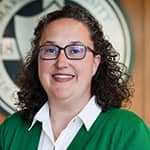 Kate Huber, EdD, OTD, OTR, serves as Associate Dean of Health Sciences and Founding Program Director of the graduate occupational therapy programs at Marian University, where she has been a member of the faculty since April 2024. With nearly two decades of experience in occupational therapy education, Dr. Huber brings expertise in curriculum development, accreditation, and interprofessional education to her leadership role.
Discover the voices of Marian University's health professions students through "Franc Notes", a vibrant, student-led blog that embodies our Franciscan commitment to community, reflection, and compassionate service. Inspired by the rhythm of "SOAP notes," it features weekly insights—from "DO Diaries" interviews with physicians to summer reflections and program spotlights—fostering collaboration across disciplines."