


Franciscan Values Art Walk • Spring
Reconciliation
Welcome to this self-guided walk across campus.
This self-guided experience invites you to explore selected artworks across campus that reflect the Franciscan value of Reconciliation. You’ll walk between buildings, engage with art from the Marian University permanent art collection, and consider how the concepts of reconciliation are illustrated in these works of art.
The Franciscan value of reconciliation, being restored to a right relationship with God through Jesus and a call to seek forgiveness with one another, informs the lives of many individuals throughout the entire year. However, spring is always a good season to connect with the renewal of self and spirit that reconciliation requires. The art of nature and the artworks featured on this walk address both the renewal of spring and the renewing of self that the Franciscan value of reconciliation helps realize. With the Franciscan value of reconciliation in mind, let’s take a walk visiting artists’ works which, from differing perspectives, challenge viewers to think critically about the concepts of reconciliation and renewal.
Jamie Higgs, Ph.D. Associate Professor of Art History and Curator of the Marian University Permanent Art Collection
Next: Walk to Allison Mansion (Stop 1)
Walking to Allison Mansion
Stop 1 • Point of Departure
Begin your walk of Reconciliation at Allison Mansion. Enter through the front door of this early twentieth-century, Arts and Crafts style home that now functions as the president’s office.
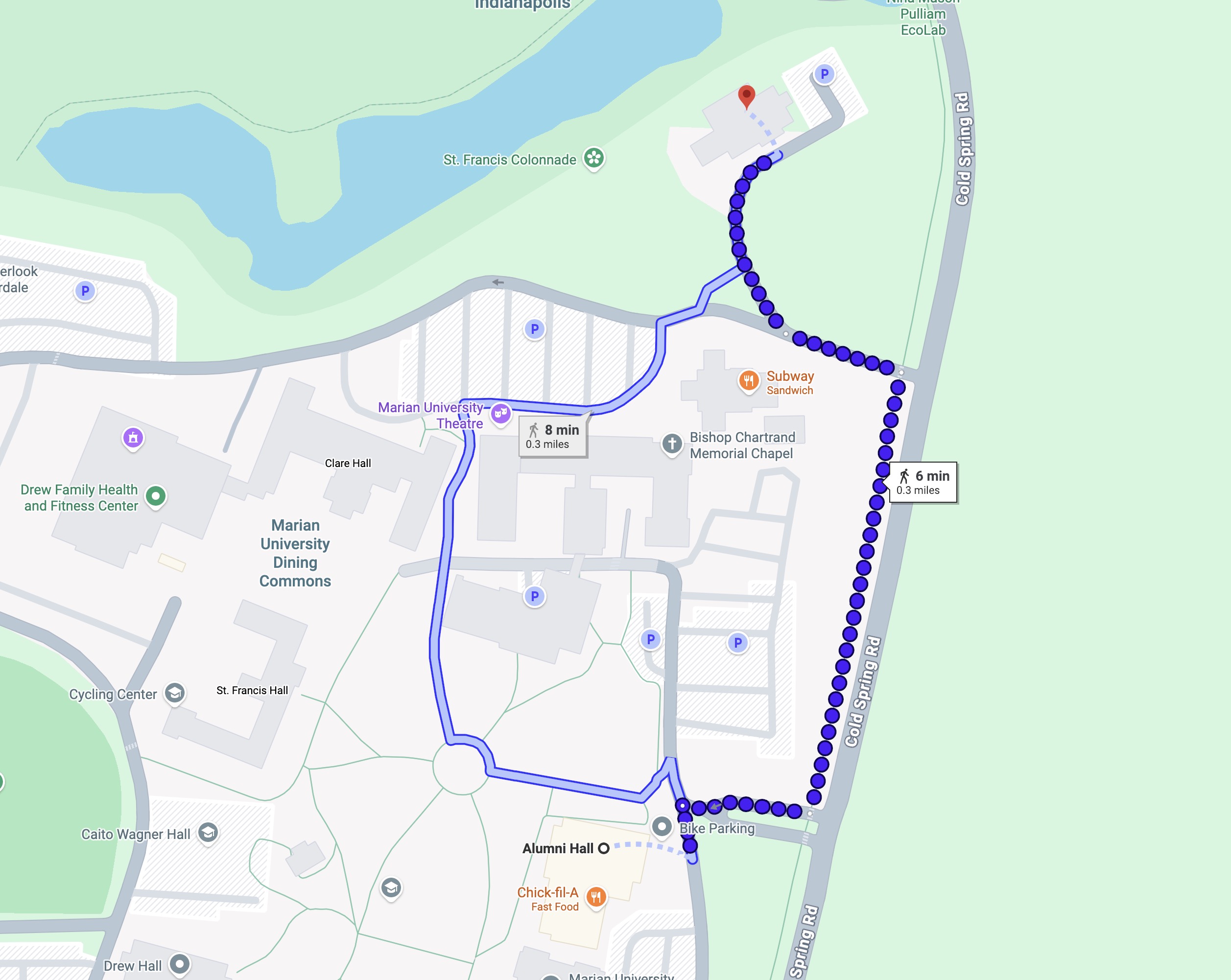
Consider what it means to seek renewal of self and spirit as you begin this walk toward reconciliation.
Front foyer, left wall • Now the President’s Office
This home was originally built by James Allison, co-founder of the Prest-O-Lite Company (maker of the first efficient automobile headlights) and a founding partner in Carl Fisher’s Indianapolis Motor Speedway. The exterior was designed by local architect Herbert Bass, the well-appointed interior by William Price of Price & McLanahan in Philadelphia. Immediately upon entering Allison Mansion’s spacious foyer, on the left wall, you will notice a rather large oil painting: a seventeenth-century work by Giovanni Battista Salvi da Sassoferrato (1609–1685) called The Holy Family.
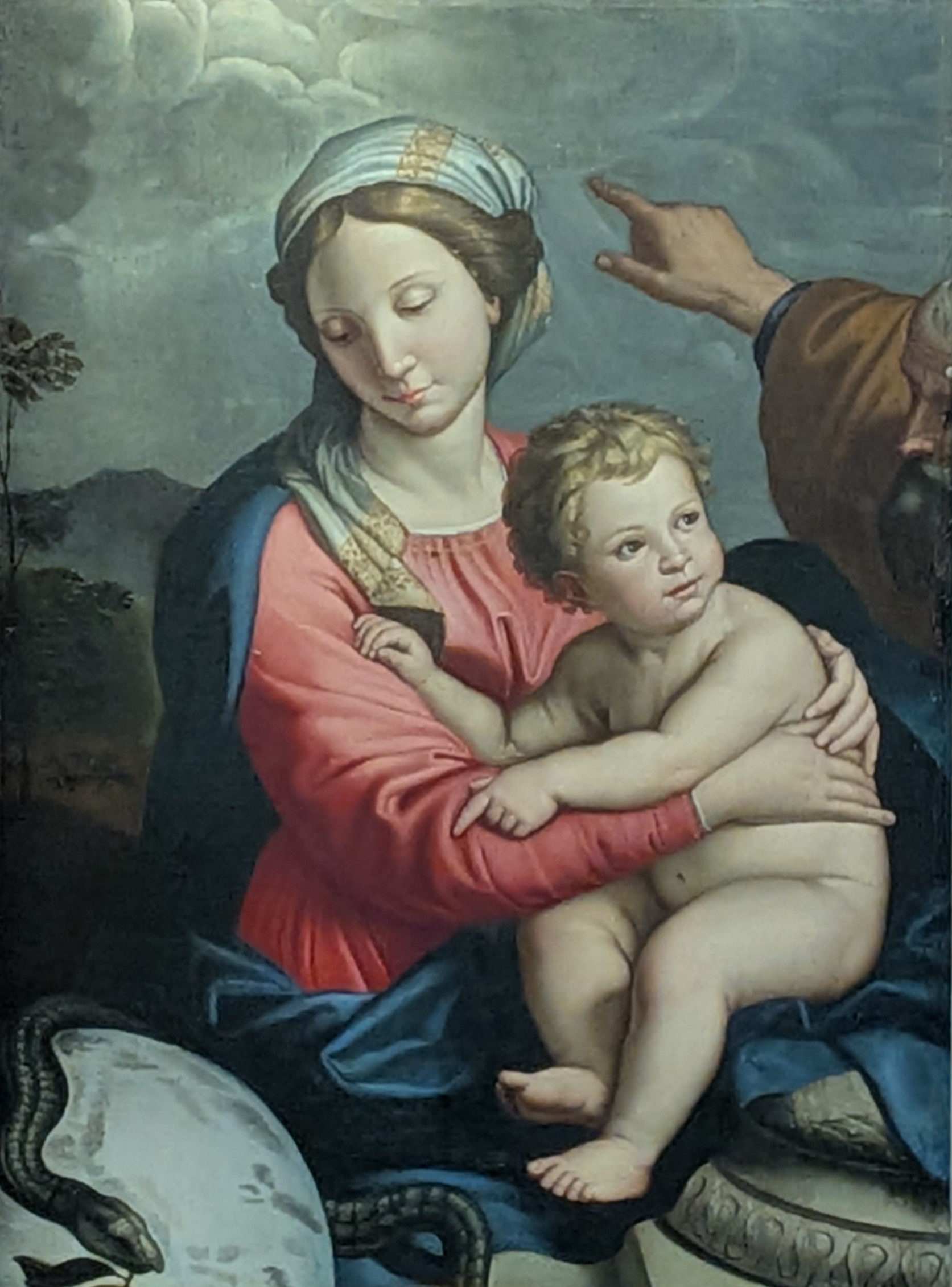
Giovanni Battista Salvi da Sassoferrato (1609–1685)
Sassoferrato was an Italian Baroque painter whose works were held in high regard up to the mid-nineteenth century before falling out of favor as overly sentimental; the late-twentieth century saw a revival of interest in his Baroque painting. There are over three-hundred works by Sassoferrato in public collections throughout the world. Scholars who have studied our painting believe it features a period frame, perhaps even the original — meaning the work may appear exactly as Sassoferrato intended, a rare example of an artist’s original concept.
The subject is dominated by a central pairing of Mary and Jesus. Mary is traditionally garbed in a red dress and blue mantle as her downcast eyes focus on an object, an orb, in the lower left. She holds her child, the toddler Jesus, securely in her arms, perched on the base of a column capital. On the far right is the figure of Joseph, who emphatically points off into the distance. Writhing around the orb at the bottom of the image is a snake, presumably a reference to Satan. When presented with such images, Christians know they reference Jesus coming into the world to reconcile Adam and Eve who, in their disobedience of God’s simple commandment not to eat from the Tree of Knowledge, brought sin into existence. So, on its surface, this image appears to be a traditional image of Jesus born into this world to, through his death, reconcile humanity to God.
Do you note any deeper symbolism that connects to the concept of reconciliation?
Select Bibliography
Jamie Higgs, Ph.D. Associate Professor of Art History and Curator of the Marian University Permanent Art Collection
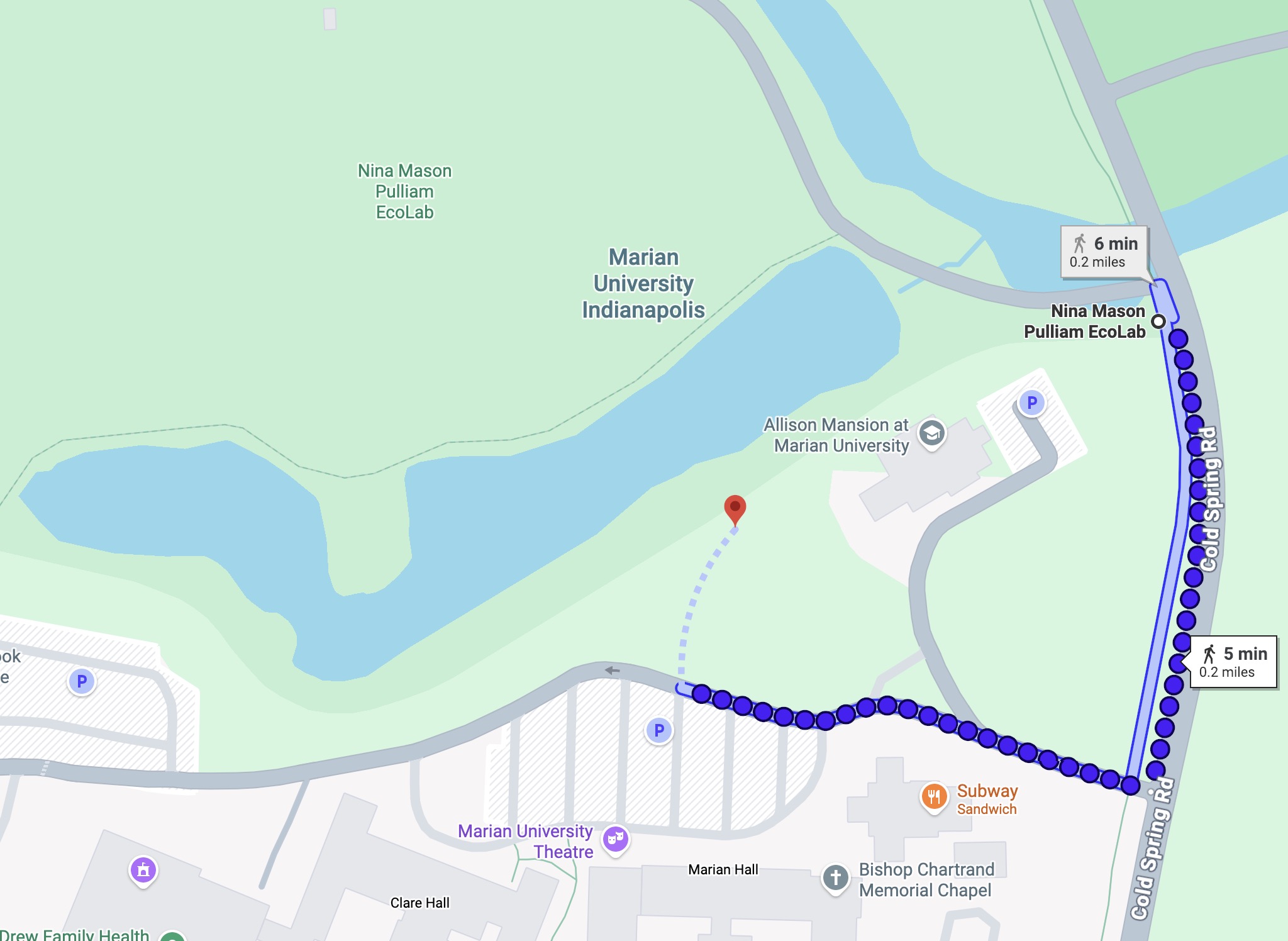
Walking to the Eco Lab
A short stroll west of Allison Mansion
To access the Eco Lab, find the steps west of and behind Allison Mansion.
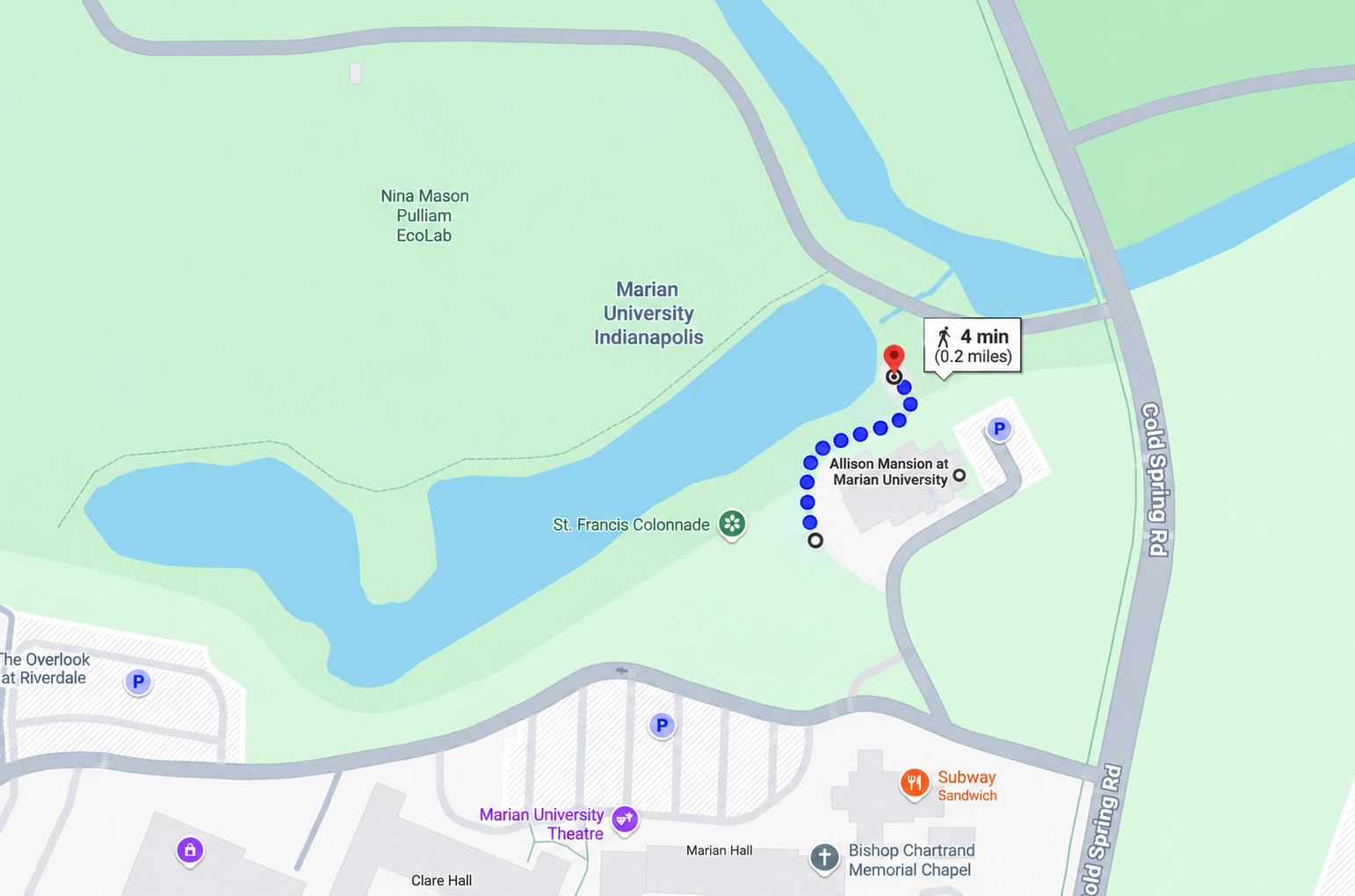
Let’s continue with the themes of renewal and reconciliation in mind by becoming one with the renewing power of the art of nature.
West of and behind Allison Mansion • Self-guided nature trail
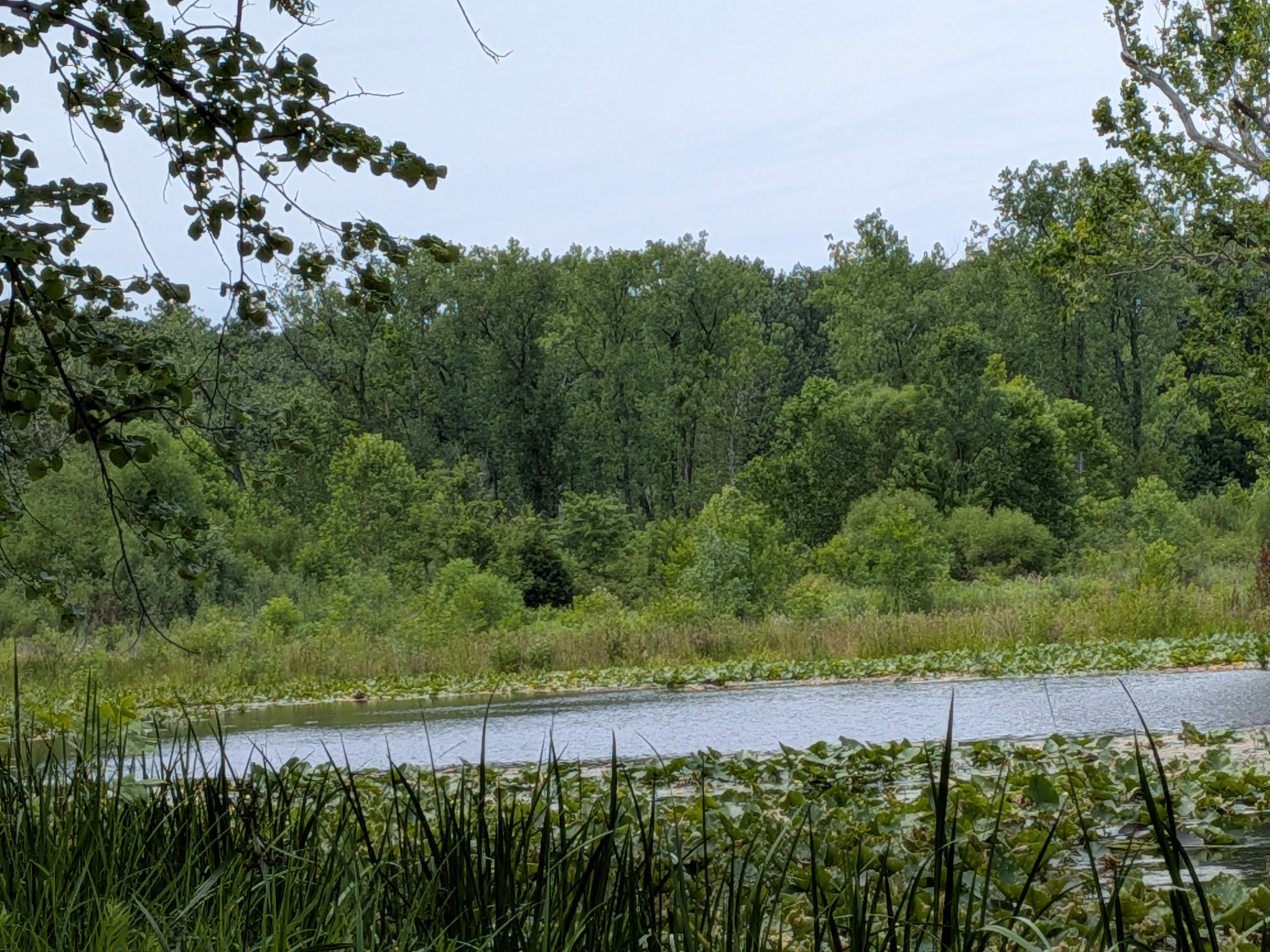
Let’s continue our spring walk with the themes of renewal and reconciliation in mind by becoming one with the renewing power of the art of nature. If you are a hiker, you can take a stroll about the Eco Lab. In its former life, the Eco Lab served as the grounds for the Allisons. They engaged the Prairie School landscape architect Jens Jensen, who made the grounds family friendly with a player’s green for dramatic readings, a semi-circular stone columned pergola, one of his signature council rings, a series of ponds, and a meadow.
In today’s Eco Lab, you will find birds galore to lift and renew your spirit — cardinals, chickadees, titmice, wood ducks, and wren fill the air with their colors and calls. If you listen closely enough, the trees, including sycamore, oak, poplar, and birch, will also whisper your name. You might spot a beaver searching for food, since beavers are pure vegetarians who favor cattails and water lily tubers; in winter, since beavers do not hibernate, they stockpile sticks to feed on in case their pond freezes.
As I walk around the Eco Lab, I often reflect on how nature is a work of art. Consider the following: the principal components of any work of art include such elements as composition, light, shadow, line, color, and, in many cases, figures that tell a story. Slowing down and strolling through the Eco Lab, with its seasonally changing composition, dappled light, playful shadows, inviting lines, verdant colors, and wildlife with their own stories to tell if only we would listen, demonstrates that the Eco Lab is nature’s art. Like the Sassoferrato image of The Holy Family, this work of art created by the hand of God can help to restore and renew our spiritual centers.
Is this the first time you have hiked through the Eco Lab? What aspects of being out in nature did you find renewing?
Jamie Higgs, Ph.D. Associate Professor of Art History and Curator of the Marian University Permanent Art Collection
Walking to the Colonnade Garden
Just west of Allison Mansion
Just west of Allison Mansion is the St. Francis Colonnade Garden.
St. Francis, patron saint of ecology, connects this next stop to both the Eco Lab and to the garden ahead — he delighted in the hand of God found in the natural world.
West of Allison Mansion • Twenty-four-pillar colonnade
Just west of Allison Mansion is the St. Francis Colonnade Garden. At its center is a statue of St. Francis. St. Francis, being the patron saint of ecology, connects our Reconciliation walk to both the Eco Lab and to the garden in which you find this statue, in that Francis delighted in the hand of God found in the natural world.
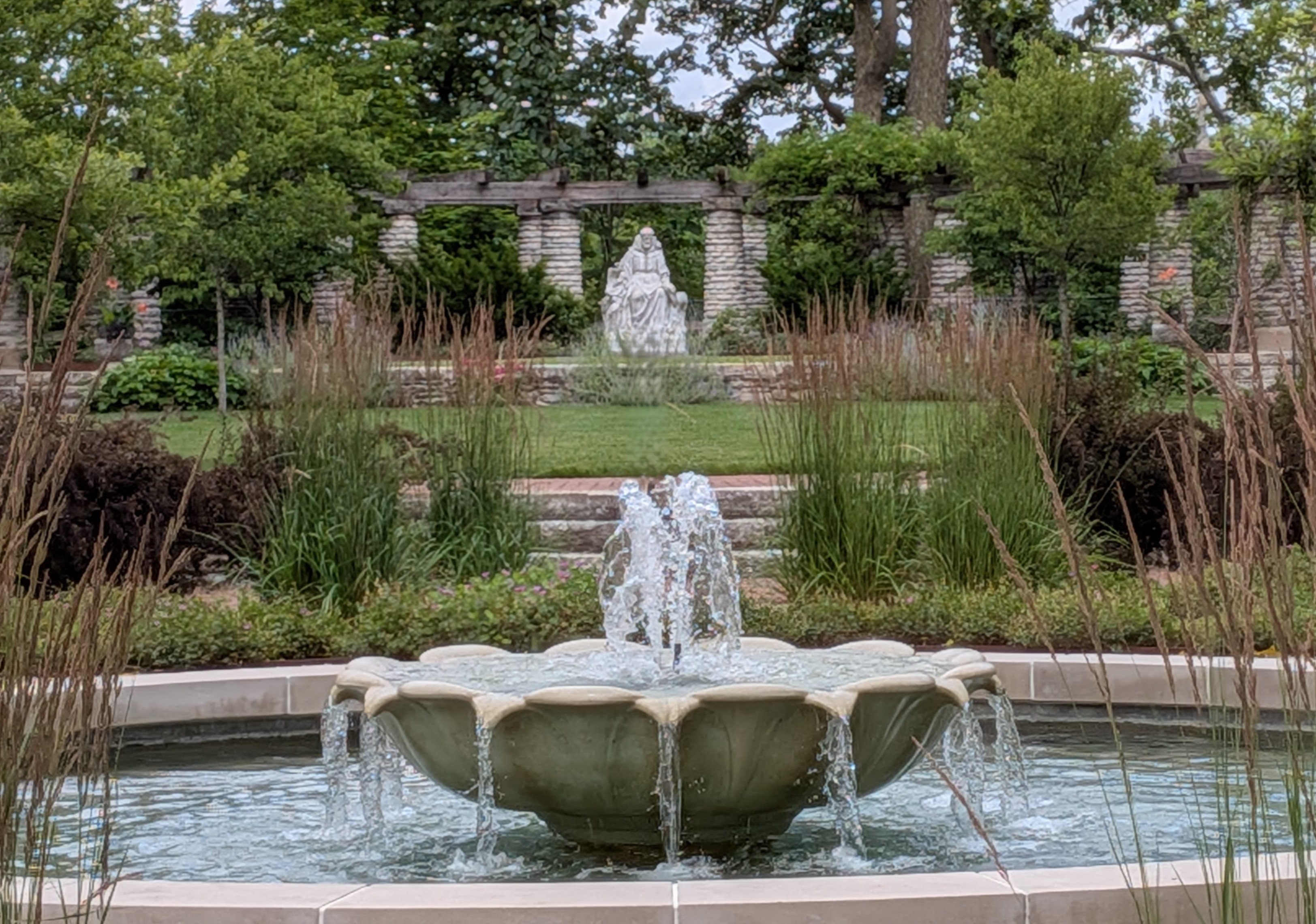
Donated 1941 by George and Helen Feldman
Our St. Francis statue depicts St. Francis seated, wearing a traditional habit cinched by a cord with three knots representing the Franciscan vows of poverty, chastity, and obedience. His head is tonsured, leaving a ring of hair that symbolizes humility. He is surrounded by all manner of woodland creatures, among them some you would find in the Eco Lab. On his left shoulder is perched a bird, and in his right hand he holds a book, referencing both the Word of God and teaching. This iconic statue was donated in 1941 by George and Helen Feldman in memory of their daughter, Georgiana, a sophomore at Marian College who passed in 1940. Today the statue fronts a twenty-four-pillar colonnade that was part of the historic grounds designed by the renowned architect Jens Jensen — fitting, since Jensen believed that nature possessed a humanizing power essential for the soul.
Do you know any other stories of St. Francis’ life that could be connected to reconciliation? For a hint, search the Wolf of Gubbio.
Select Bibliography
Jamie Higgs, Ph.D. Associate Professor of Art History and Curator of the Marian University Permanent Art Collection
Walking to Marian Hall
Marian Hall Chapel
At this juncture, make your way to the Marian Hall chapel. In the chapel, you will find the San Damiano Cross.
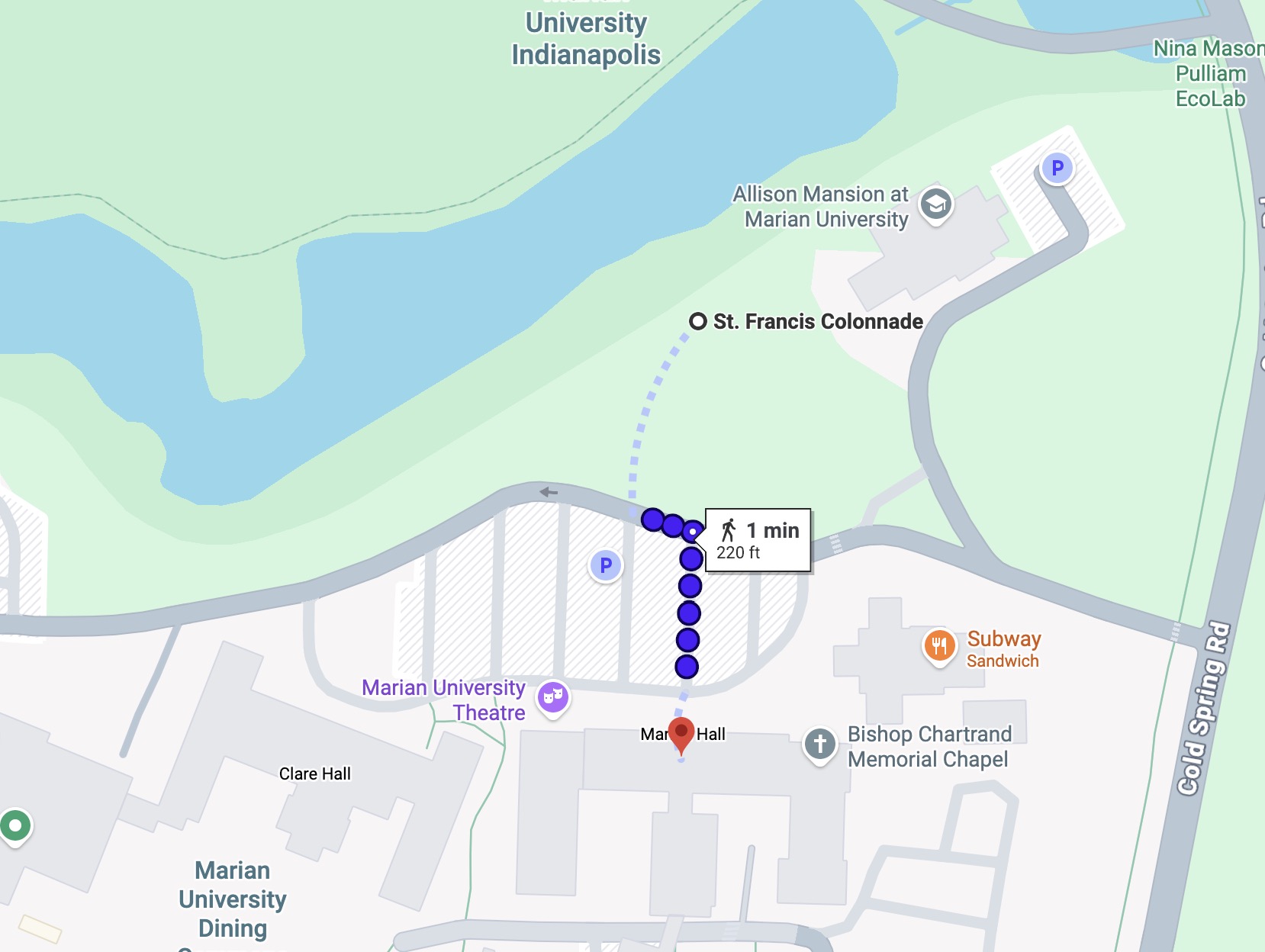
What will the San Damiano Cross tell us about renewal and reconciliation?
Marian Hall Chapel & theater-end hallway (west side)
According to tradition, in 1205 St. Francis (1181–1226) found himself praying in front of a cross located in the San Damiano chapel. During one of his meditations, he received a revelation from the Lord to rebuild the Church.
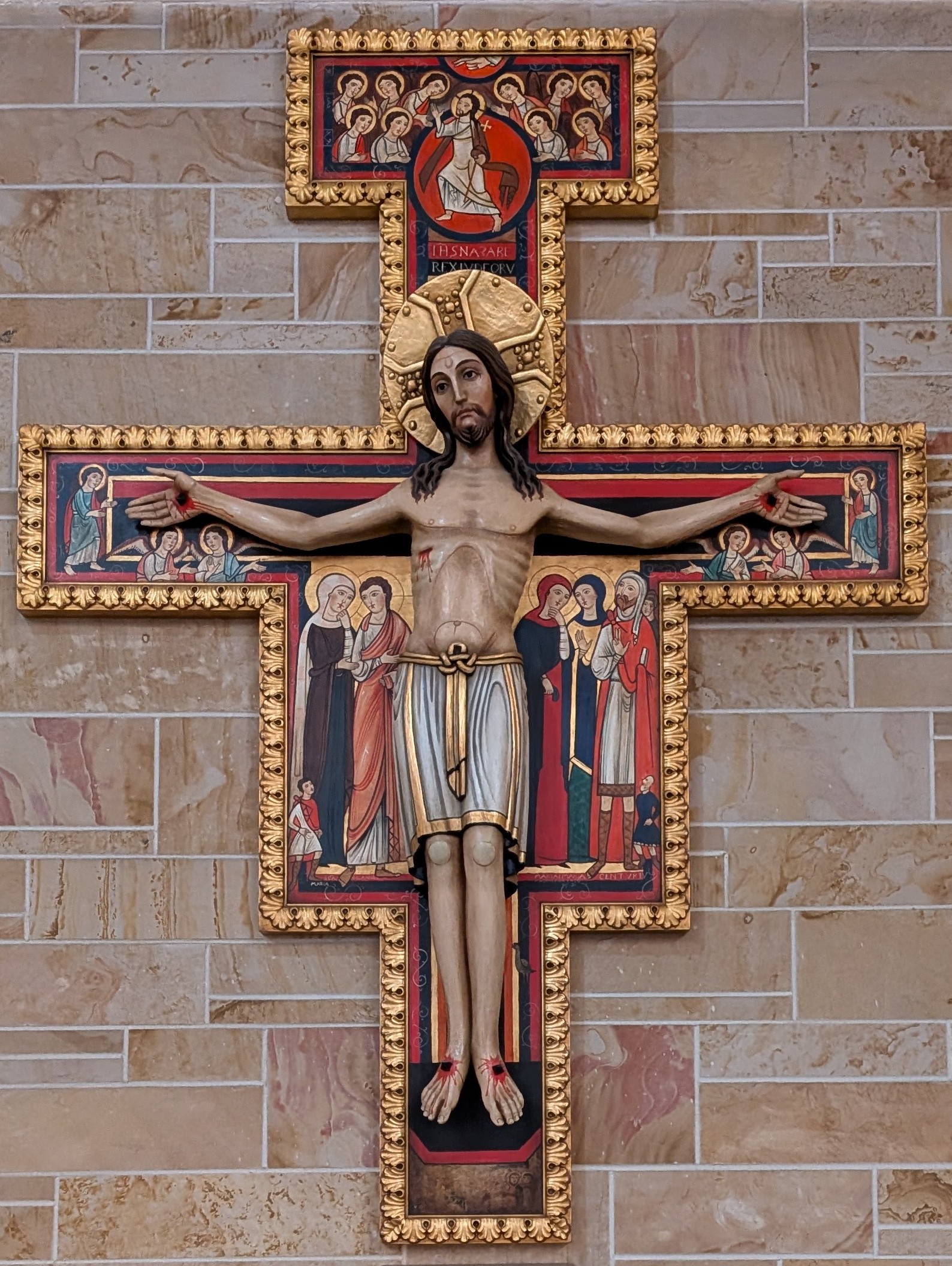
Twelfth-century icon crucifix
Before him, Francis saw what theologians and art historians now call the San Damiano Cross — a twelfth-century icon crucifix, meaning it is covered with figures in addition to the body of Jesus. Jesus’ arms are lean, his body emaciated, his ribs gaunt, sunken, cavernous. Blood seeps from his hands, feet, and the wound in his side. His face suggests a subtle resignation as regards his destiny. Placed above Jesus’ head is a secondary representation of the Savior in a mandorla, fully clothed and carrying a cross as a scepter. The other figures, ten in all, represent angels welcoming him to Heaven, all blessed by the disembodied hand of God descending upon the scene.
Surrounding the body of Jesus are five additional figures — Mary and St. John on the left, and Mary Magdalene, Mary (mother of James), and the centurion on the right, who in the Gospel of Mark proclaims, “Truly this is the Son of God” (Mark 15:39). Iconographically, what does it all mean? It is quite simple really. Just as the figures in the center are witnesses to Jesus’ sacrifice, we too are witnesses. Past and present merge in the shared space of the cross with the worshipper and the shared knowledge of Jesus’ sacrifice — the event that, in Christian teaching, redeems humanity and reconciles humanity to God. I often think St. Francis heard God’s call here because literally the San Damiano chapel, in the thirteenth century, was in a ruinous state; it needed to be physically rebuilt. But Francis went beyond rebuilding that chapel to figuratively rebuilding the Church itself.
What can you rebuild in your life? Commitment to the classroom and your academic success, a friendship, something even deeper?
Petrie Joan Bertolis Bradley Collection
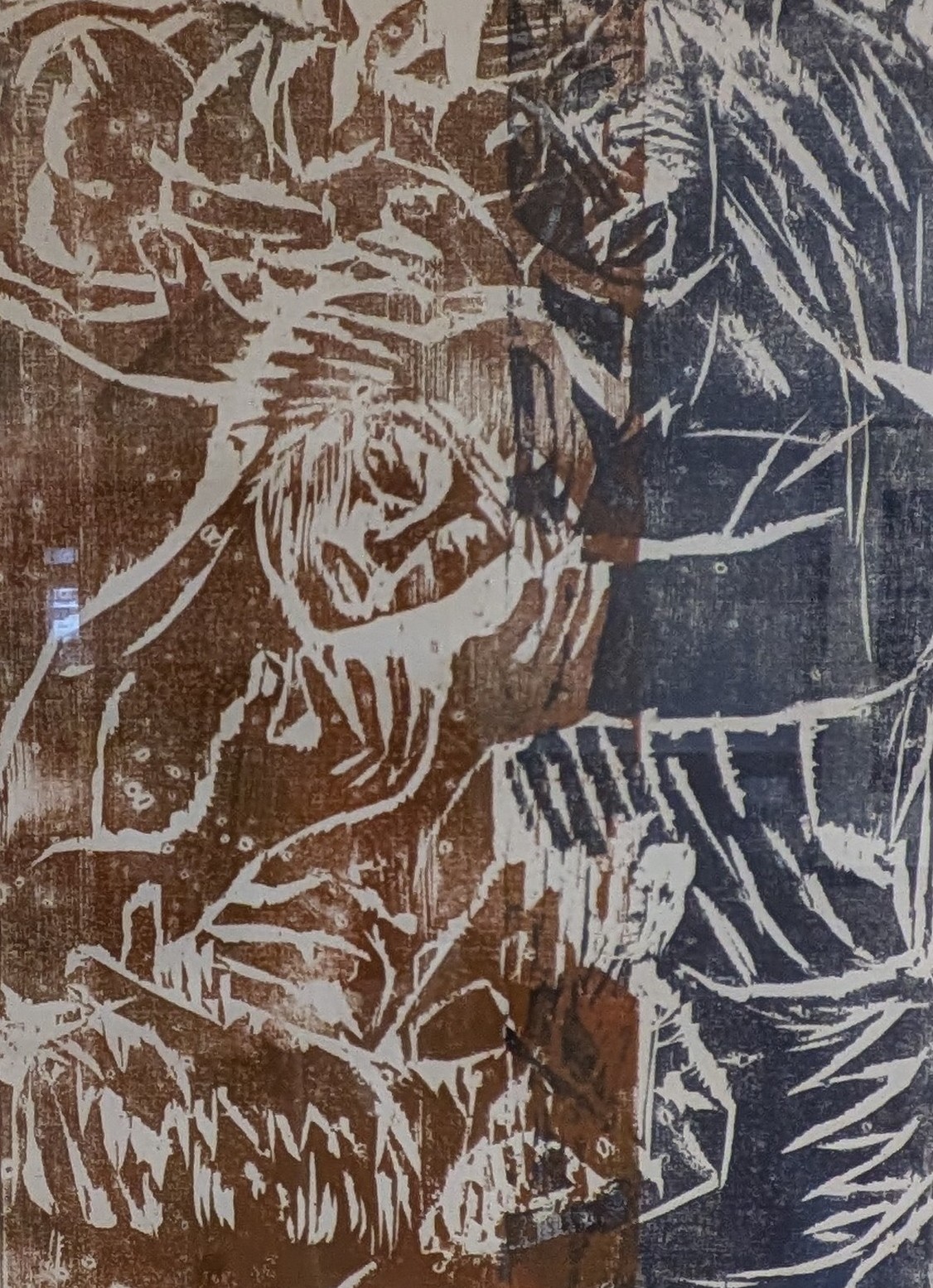
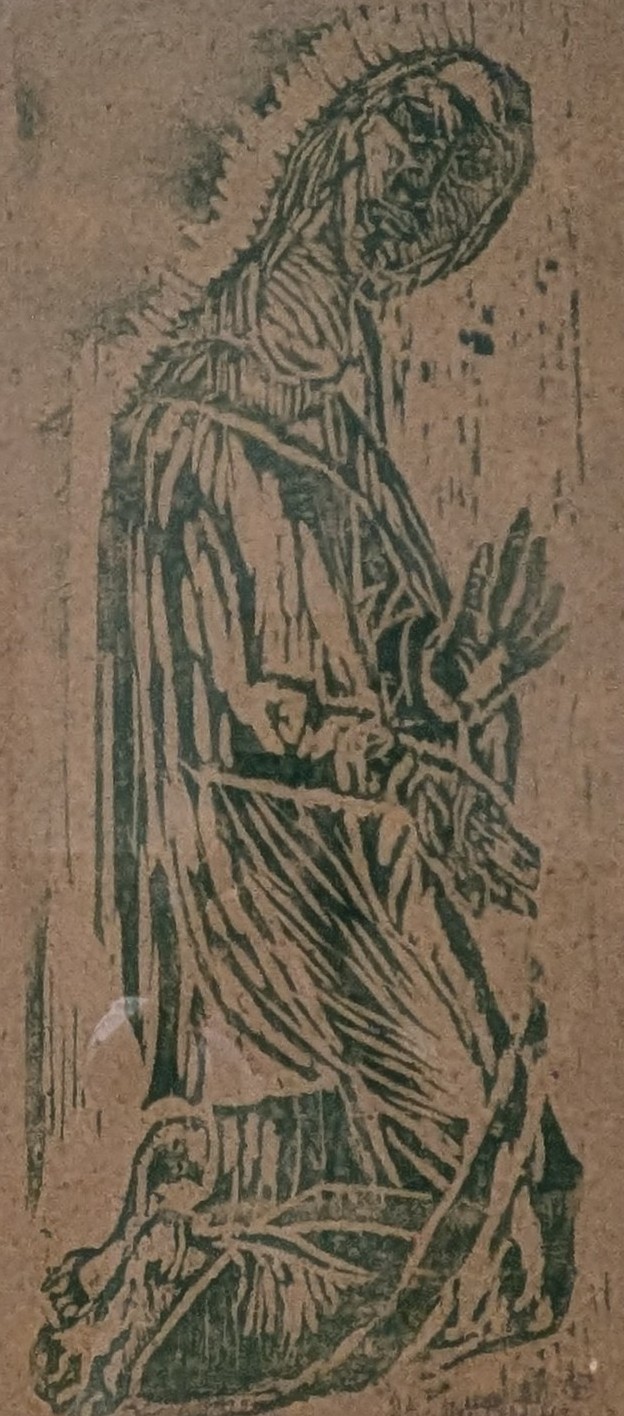
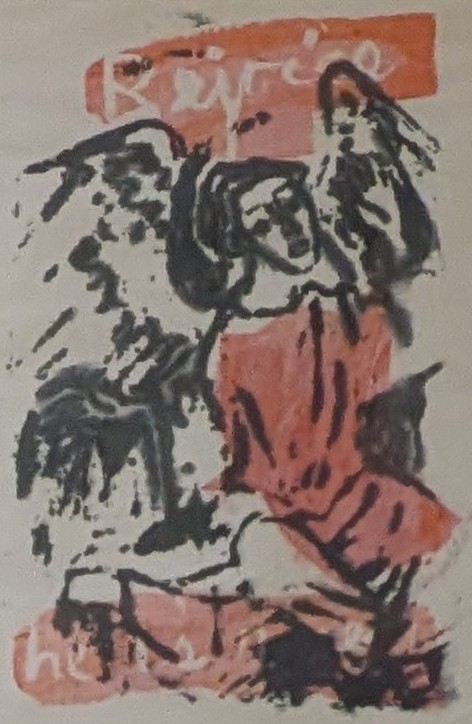
3 of 17 featuredBefore leaving Marian Hall, walk west towards the theater exit and note the seventeen prints on display. These are the work of Petrie Joan Bertolis Bradley (1906–1973), born in Vilnius, Lithuania, whose family immigrated to America and settled in Illinois. Her family describes two constants in her life: her abiding faith and her love of the arts. The works displayed here showcase her expertise in woodcut, etching, and lithography — brilliant abstract compositions with underlying Christian symbolism grounded in themes around spiritual struggle and redemption, central to our Franciscan value of reconciliation and this walk’s theme of renewal.
Petrie Joan Bertolis Bradley (1906–1973)
Petrie’s Nativity illustrates an abstract portrayal of the traditional Nativity scene printed in brown and dark bluish tones. In the foreground, Mary cradles the infant Jesus. Regardless of the identities of the background figures, any Nativity scene has at its core, with Christ being born into this world, a message around the reconciliation of humanity to God and a renewal of spirit.
Petrie Joan Bertolis Bradley (1906–1973)
This print presents the viewer with a simple kneeling figure executed in green tones. Surrounding the figure’s head is a halo created from the white of the paper rather than colored ink. The figure’s arms are raised in an orant position — an ancient attitude of prayer dating to the Greeks and Romans — blended, I think, with echoes of the Buddhist Abhaya and Varada mudras. Regardless of your interpretation, prayer and reflection exist as spaces to reconcile our thoughts and feelings to a spiritual centering.
Petrie Joan Bertolis Bradley (1906–1973)
This print focuses only on portraying the angel that delivered that message because, of course, since Christ is risen, his physical body is not to be seen. The angel is executed in black outline with red swatches of ink forming the body and two banners above and below in which the text is written. This simple but powerful image, in referencing the resurrection, suggests the fulfillment of humanity’s reconciliation with God.
What other references to the concepts of reconciliation or renewal do you find in these works?
Acknowledgments
Jamie Higgs, Ph.D. Associate Professor of Art History and Curator of the Marian University Permanent Art Collection
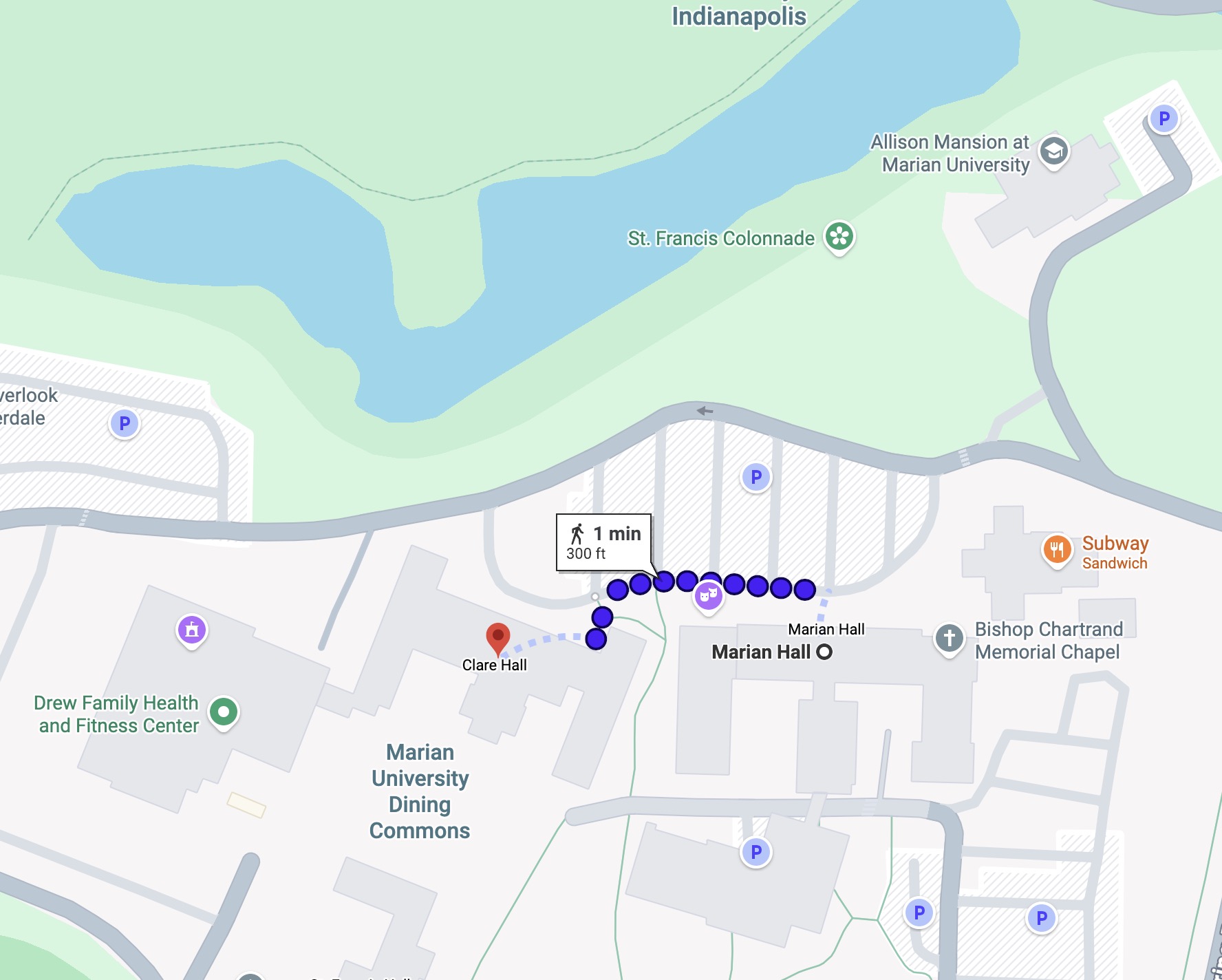
Walking to Clare Hall Student Dining Commons
Walk time to be confirmed
Exit Marian Hall through the west door and take a left. Make your way to the Clare Hall Student Dining Commons. Enter this building from the patio, through the east door.
Reflect on how the San Damiano Cross and the Bertolis Bradley prints connect to themes of reconciliation and renewal.
Enter from the patio, east door • Dining area
To the right of the dining area is a large blue-hued mural by Texas artist Doug Jaques (1946–2013). Our mural, entitled Christ the Teacher, was donated to the university by the Doyle Family in 2007 and is an example of transcendent mystery.
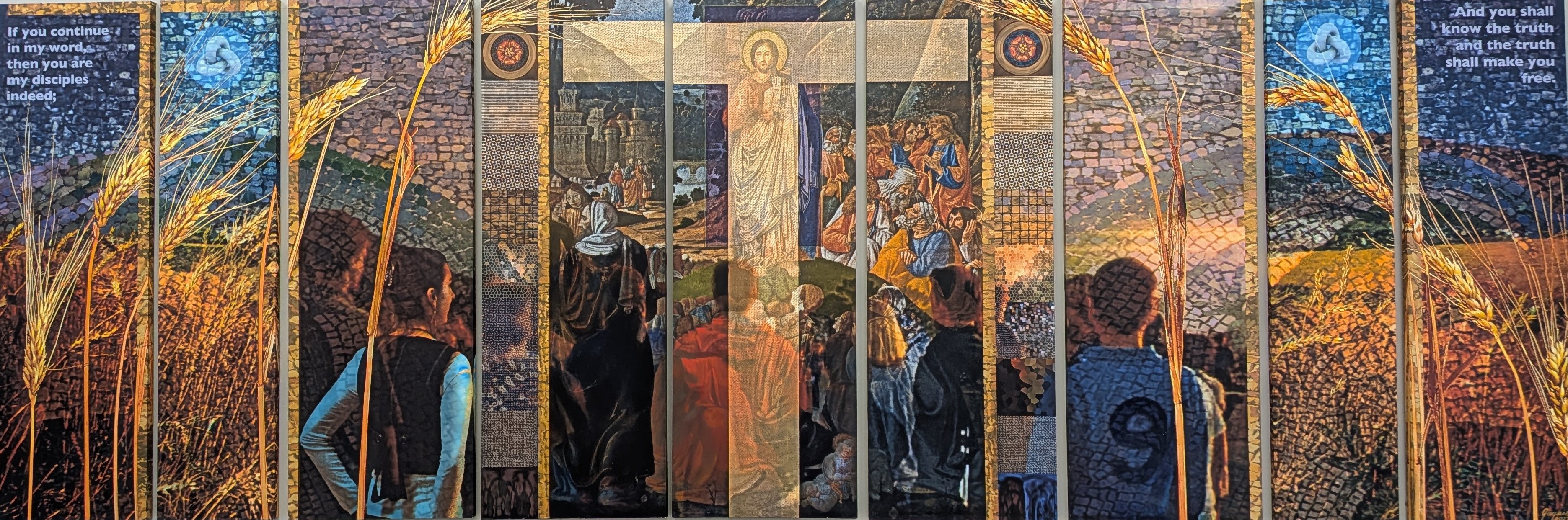
Doug Jaques (1946–2013) • Donated by the Doyle Family, 2007
In it we see a central figure of Jesus against a Tau cross. Historically, tau, the last letter of the Hebrew alphabet, functioned similarly to the Greek letter omega appearing in the Book of Revelation: “I am the Alpha and the Omega, the beginning and the end” (Rev 21:6) — so tau references the eternal nature of Jesus. The Tau cross also connects to the life of St. Francis, who often marked letters using the Tau cross as a seal, a sign of deep spiritual conviction.
Around Jesus, a crowd of historic and contemporary types, young and old, male and female, and multi-racial, gather to hear his message. Note the sheaves of wheat growing, not harvested — a reference to the bread that becomes the body of Jesus during Mass, but growing to indicate that the body lives, Jesus lives. Two quotes are located at the top of the first and ninth panels: “If you continue in my word, then you are my disciples indeed,” and “And you shall know the truth and the truth shall make you free” (John 8:31–32). The central question to understanding this mural is identifying what Jesus is teaching. It seems, by way of the chosen quotes and the imagery, Jesus is teaching all those tenets, and being a university, we are called to teach those ideals to our students, to each other, and to our larger communities.
Doug Jaques viewed his art making through the lens of art-as-icon. As we’ve learned, the San Damiano Cross is also an icon — an icon cross. In what ways do the San Damiano Cross and Jaques’ Christ the Teacher both belong to the icon tradition?
Jamie Higgs, Ph.D. Associate Professor of Art History and Curator of the Marian University Permanent Art Collection
Walking to Alumni Hall
Walk time to be confirmed
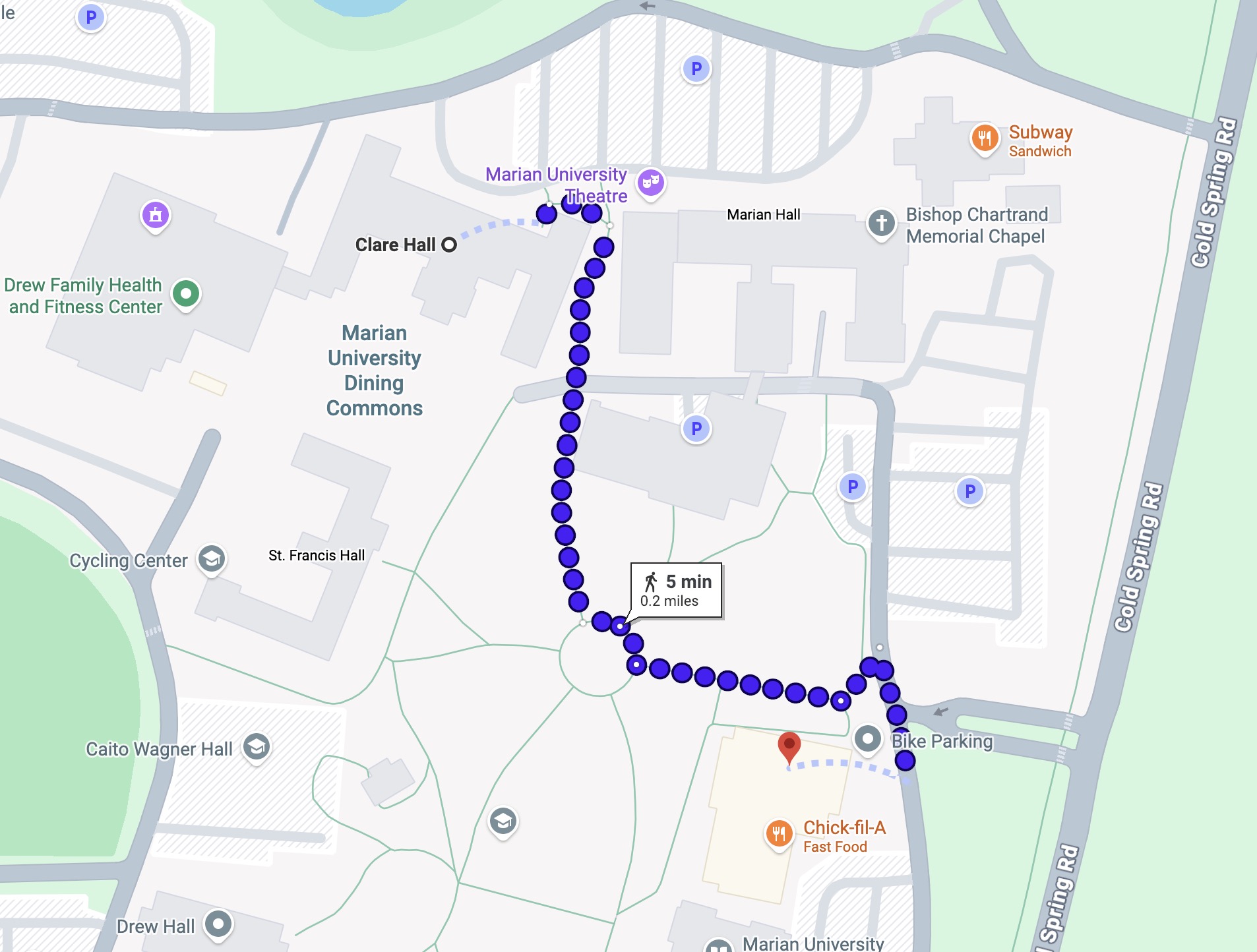
Exit the Student Dining Commons and make your way to Alumni Hall. Look for the sculpture on the front (south) side, facing Cold Spring Road.
Consider how Christ the Teacher’s call to community connects to the family imagery you’re about to encounter.
South side, facing Cold Spring Road
On the front side, the south side, facing Cold Spring Road, is a monumentally scaled, high-relief sculpture of The Nativity. This eight-ton brick and mortar work was designed by Nebraskan artists Jay Tschetter, Susan Horn, and Sten Eisentrager of Images in Brick, located in Denton, Nebraska. Installation on our campus took place in 2015.
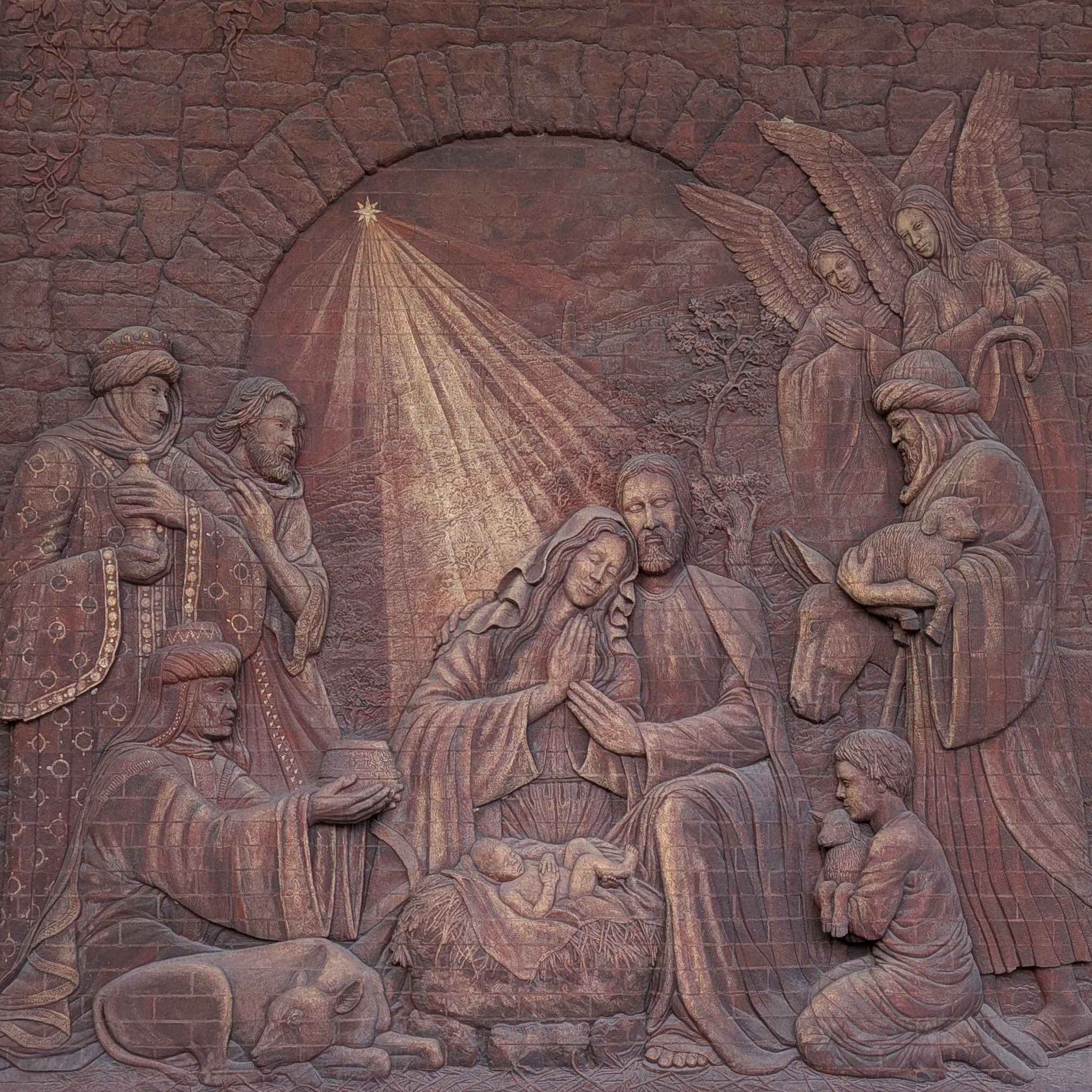
Jay Tschetter, Susan Horn & Sten Eisentrager, Images in Brick • Installed 2015
The work is dominated by a central image of Mary embraced by Joseph. Both gaze down at their newborn, Jesus, who sleeps peacefully. The magi, with their traditional gifts of gold, frankincense, and myrrh, approach from the left. The shepherds, with a donkey and a sheep, approach from the right. To complete the humble nature of the scene, a cow is pictured in the foreground. Angels on the right and the abiding Light of God to the upper left witness this event that reconciles humanity to God.
Not so much a question as a recommendation: the purpose of this mural is to remind students of the central place of family in their lives. Call your mamas (your daddas and your siblings too) throughout the semester — they miss hearing from you.
Jamie Higgs, Ph.D. Associate Professor of Art History and Curator of the Marian University Permanent Art Collection
Walking to the Hackelmeier Memorial Library
Walk time to be confirmed
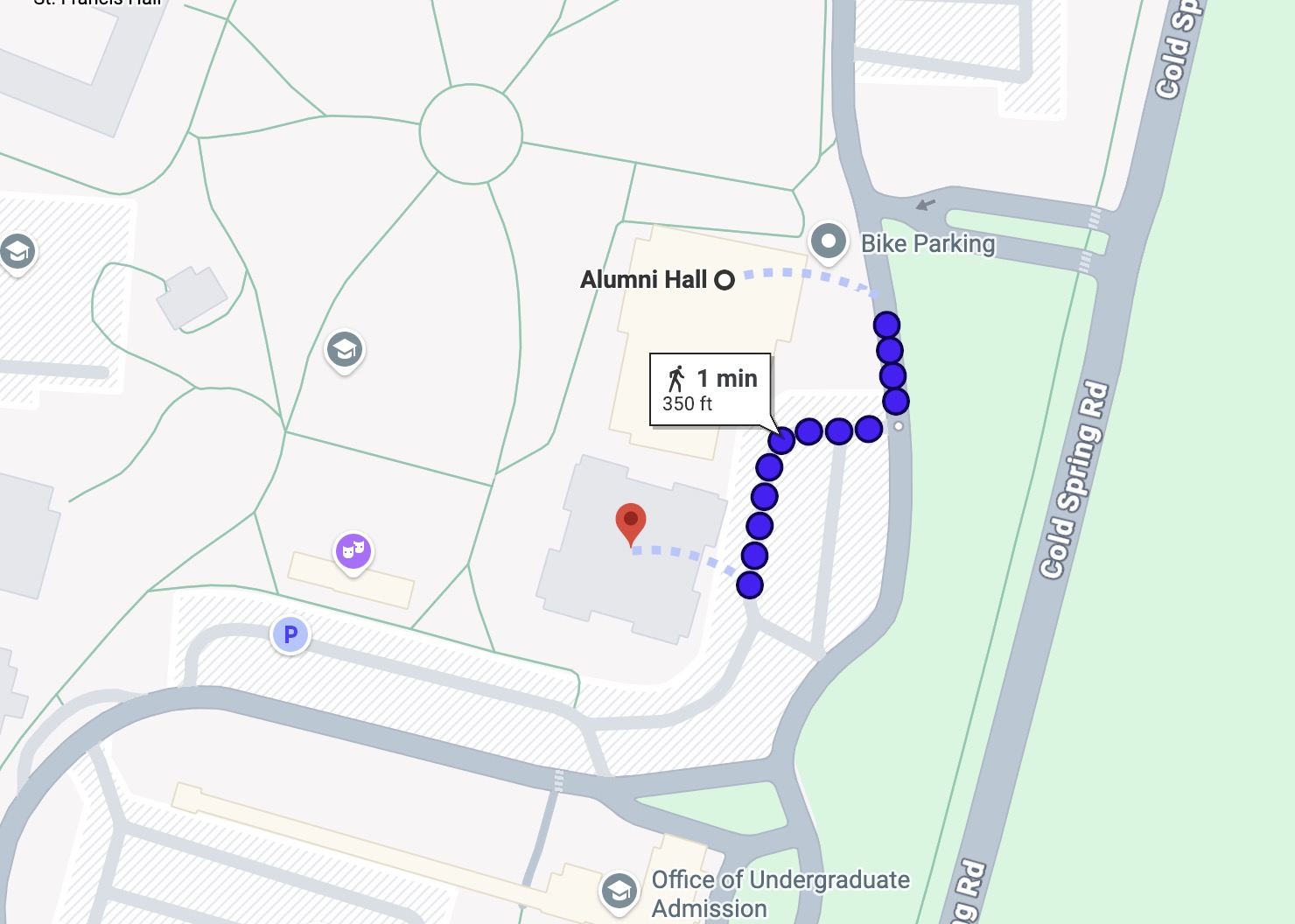
From Alumni Hall, make your way to the Hackelmeier Memorial Library, where the St. John’s Bible is displayed on the main floor.
Reflect on how the Holy Family imagery you’ve now seen at three stops carries a consistent thread of renewal.
The St. John’s Bible • Ask a librarian to locate any folio
The St. John’s Bible
The St. John’s Bible is the result of a collaboration between Donald Jackson, internationally recognized illuminator and calligrapher, and the monks of St. John’s Abbey, Collegeville, Minnesota. Creating the first hand-written, hand-illuminated bible since the Middle Ages was Donald Jackson’s dream from a young age. Bringing together a Committee on Illuminations and Text (CIT), which included historians, theologians, calligraphers, and illuminators, the committee decided this bible would approach the text through an ecumenical lens rooted in Benedictine spirituality. The St. John’s Bible is maintained by the Hackelmeier Memorial Library librarians, and they are always happy to show visitors the bible, particularly any of the folios highlighted below.
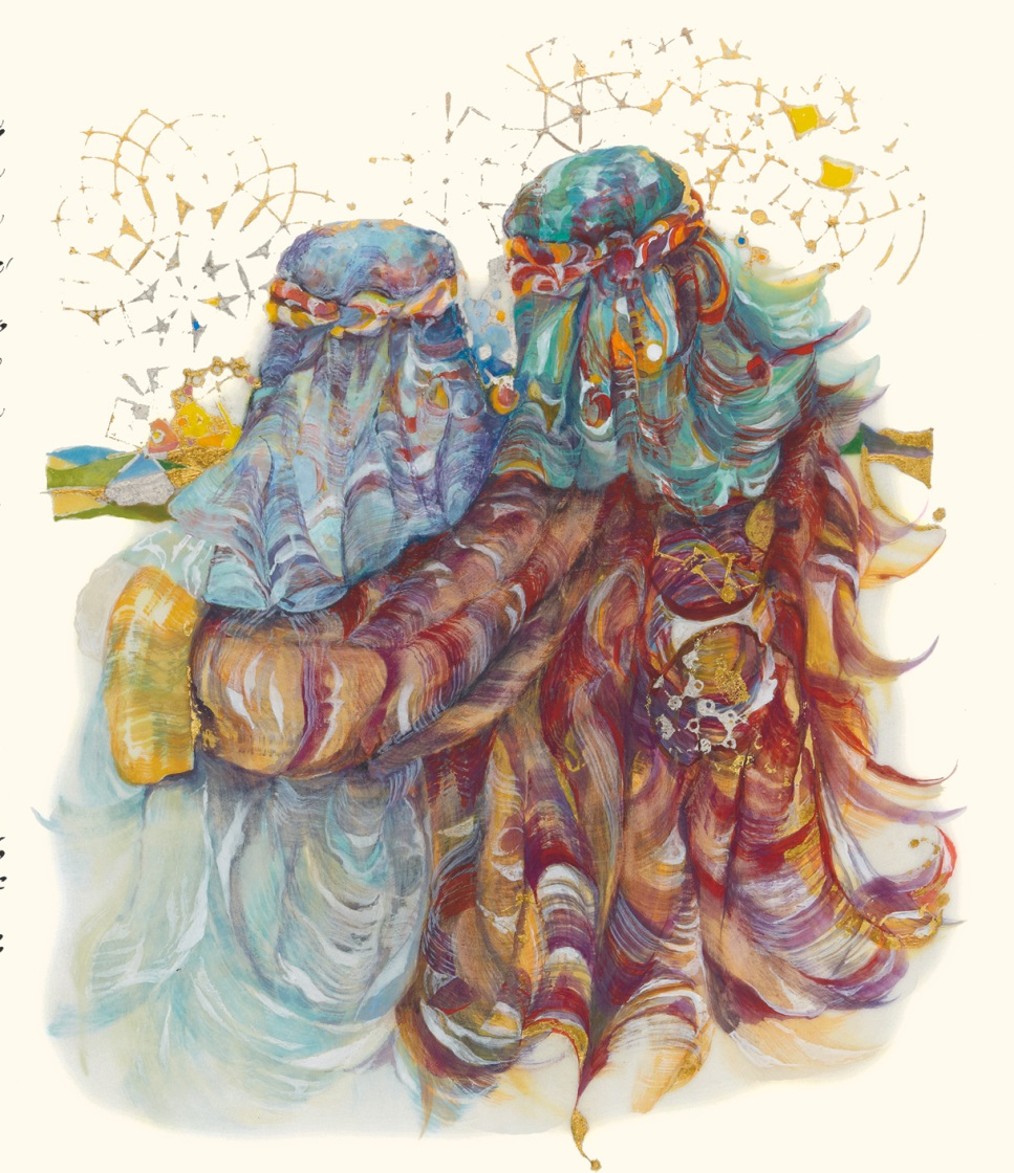
Moore, © 2010 • The St. John’s Bible, St. John’s University, Collegeville, Minnesota, USA
Ruth and Naomi takes us into the world of Ruth, Orpha, and Naomi. Owing to a famine, Naomi, an Israelite from Bethlehem, emigrates to the land of Moab with her husband and two sons. After losing all three men, her two Moabite daughters-in-law are freed to return to their families — but Ruth powerfully refuses, stating, “Where you go, I will go. Where you lodge, I will lodge. Your people shall be my people and your God my God” (Ruth 1:16–17). What I love about this image is that it is unclear who among the two women is the immigrant. It is simply an image of reconciliation as they look towards God’s plan for their futures — contented peace between women holding on to one another for support, reconciled to a right relationship with one another and with God’s plan.
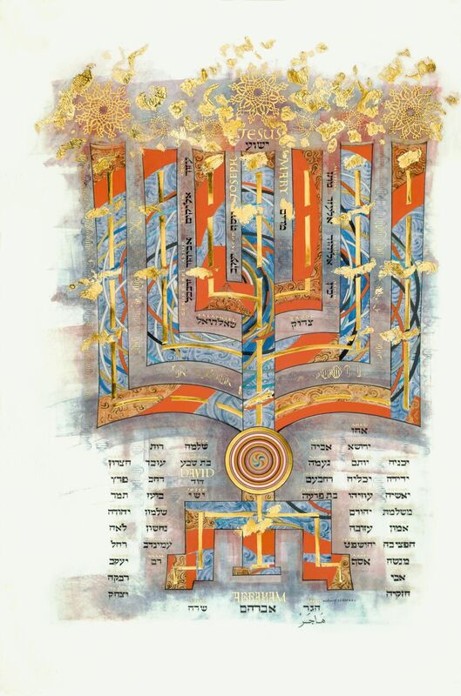
Jackson, © 2002 • The St. John’s Bible, St. John’s University, Collegeville, Minnesota, USA
The Genealogy of Jesus speaks to reconciliation through the shared connection of all seekers of enlightenment by alluding not only to the roots of Christianity in Judaism but to other faith traditions. Jesus’ family tree is represented as a menorah — his name at the top, Abraham’s at the bottom, with many of the women in his family tree, often overlooked in the West’s patriarchal accounts, included along the way. The menorah also contains mandala patterns from Tibetan Buddhism, arabesque-shaped flames from Islamic art, and gilded stamps from Qur’an illuminations. With these textual and symbolic connections, the CIT and Jackson sought to find reconciliation between humanity’s many faith traditions as shared seekers of enlightenment.
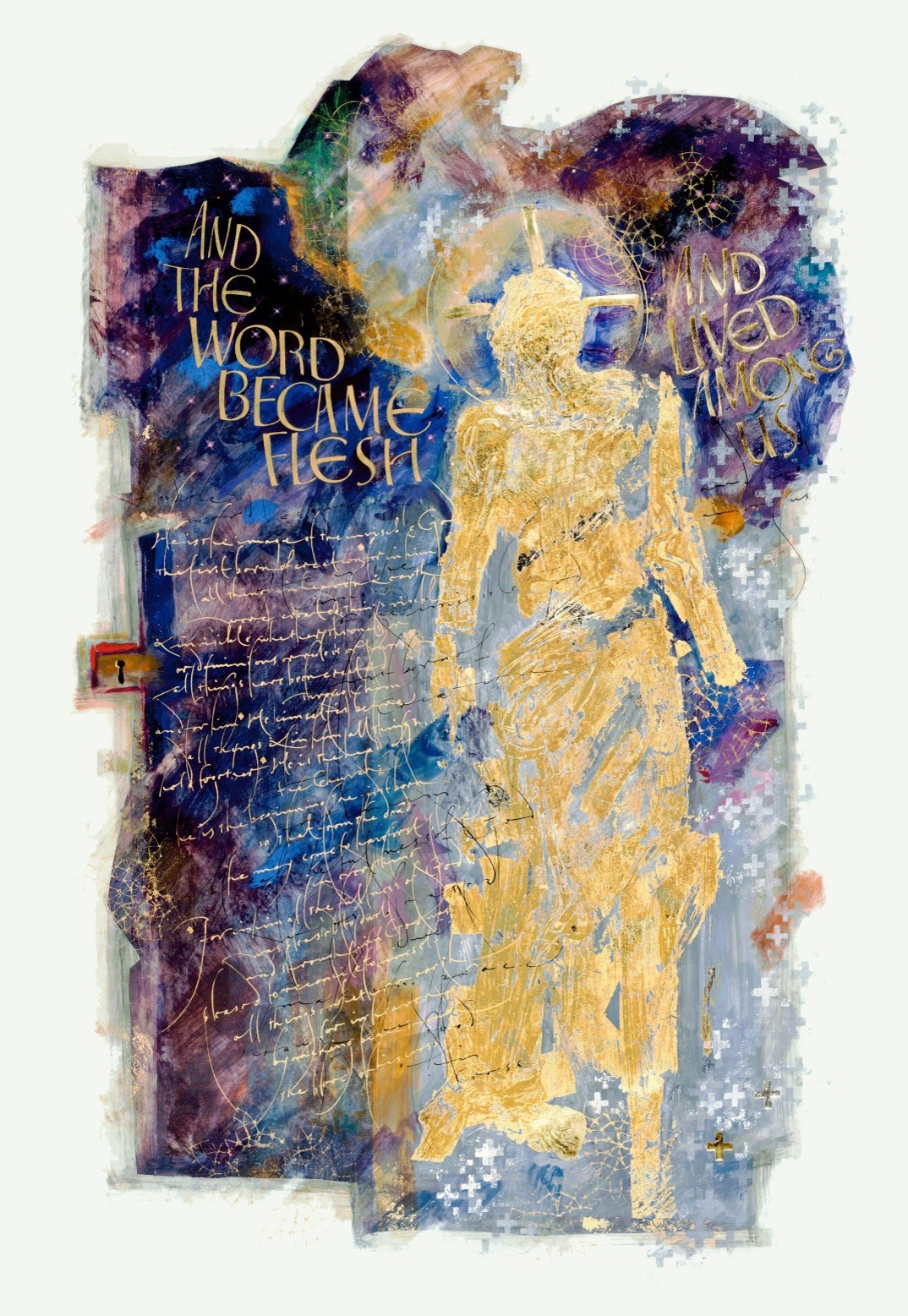
Jackson, © 2002 • The St. John’s Bible, St. John’s University, Collegeville, Minnesota, USA
The Word Made Flesh depicts a silhouetted gold figure forming out of the swirling background of the cosmos, representing chaos and nothingness moving towards light and order. Written in large bold letters at the top are the words, “And the word became flesh, and lived among us.” The cosmic soup of blue and purple hues in the background are paintings based on images from the Hubble telescope — uniting our understandings of science and space exploration with faith and questions around ultimacy, and pointing to the cosmic, infinite nature of Wisdom becoming finite through the person of Jesus, who will give his finite life to eternally reconcile humanity to God.
What other elements of these three illuminations or other St. John’s Bible illuminations (in terms of subject, mood, style, or technique) illustrate any of the concepts of reconciliation or renewal?
Selected Bibliography
Jamie Higgs, Ph.D. Associate Professor of Art History and Curator of the Marian University Permanent Art Collection
Walking to the Evans Center
Final stop • Walk time to be confirmed
From the Hackelmeier Memorial Library, make your way to the Evans Center. Enter from the east doors — Karen Glanders’ mosaics are found in the first-floor hallway.
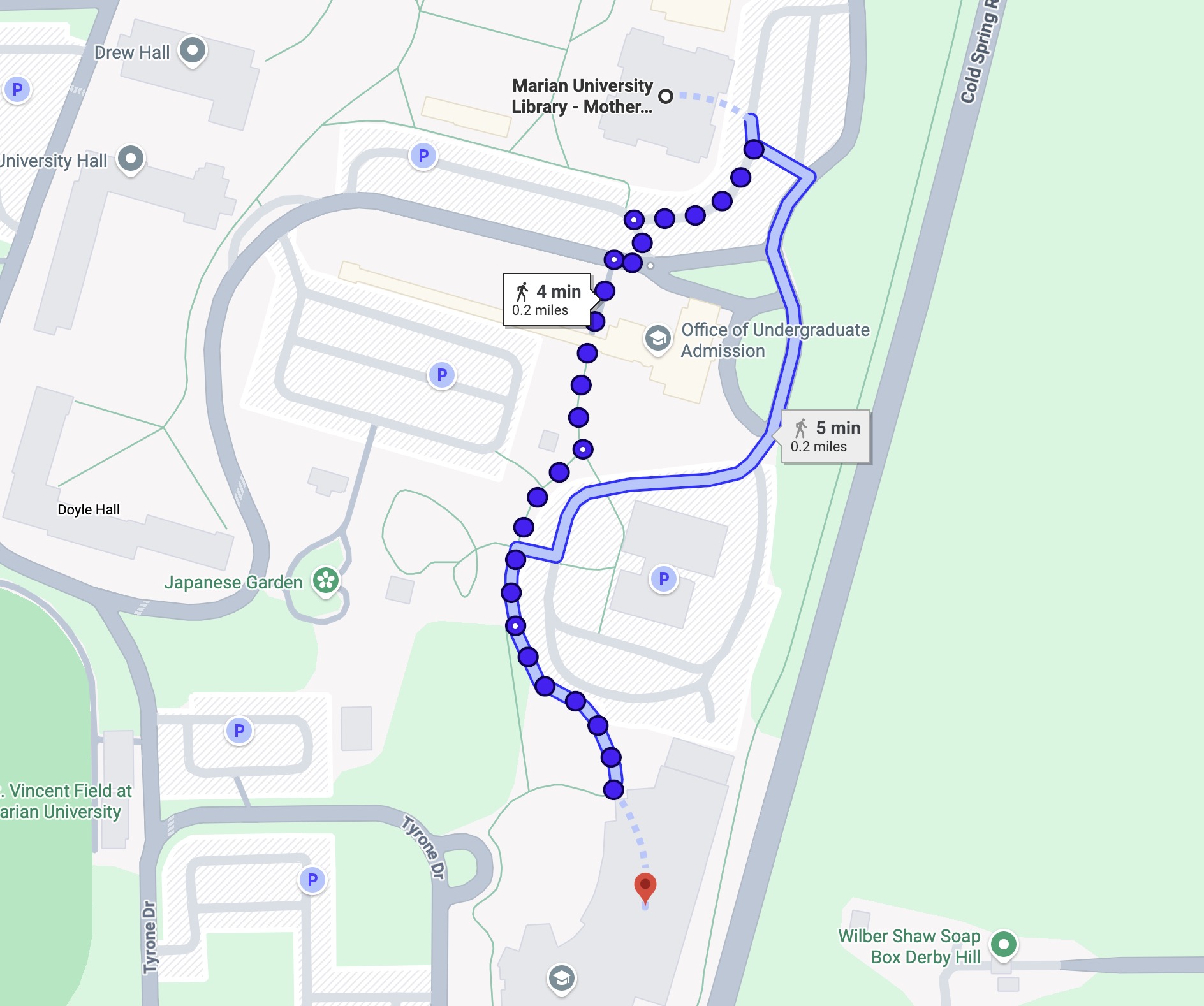
Consider how the St. John’s Bible forges a deep partnership between faith and reason as the foundation to the Franciscan values, including reconciliation.
First-floor hallway • Enter from the east doors
Karen Glanders (1936– )
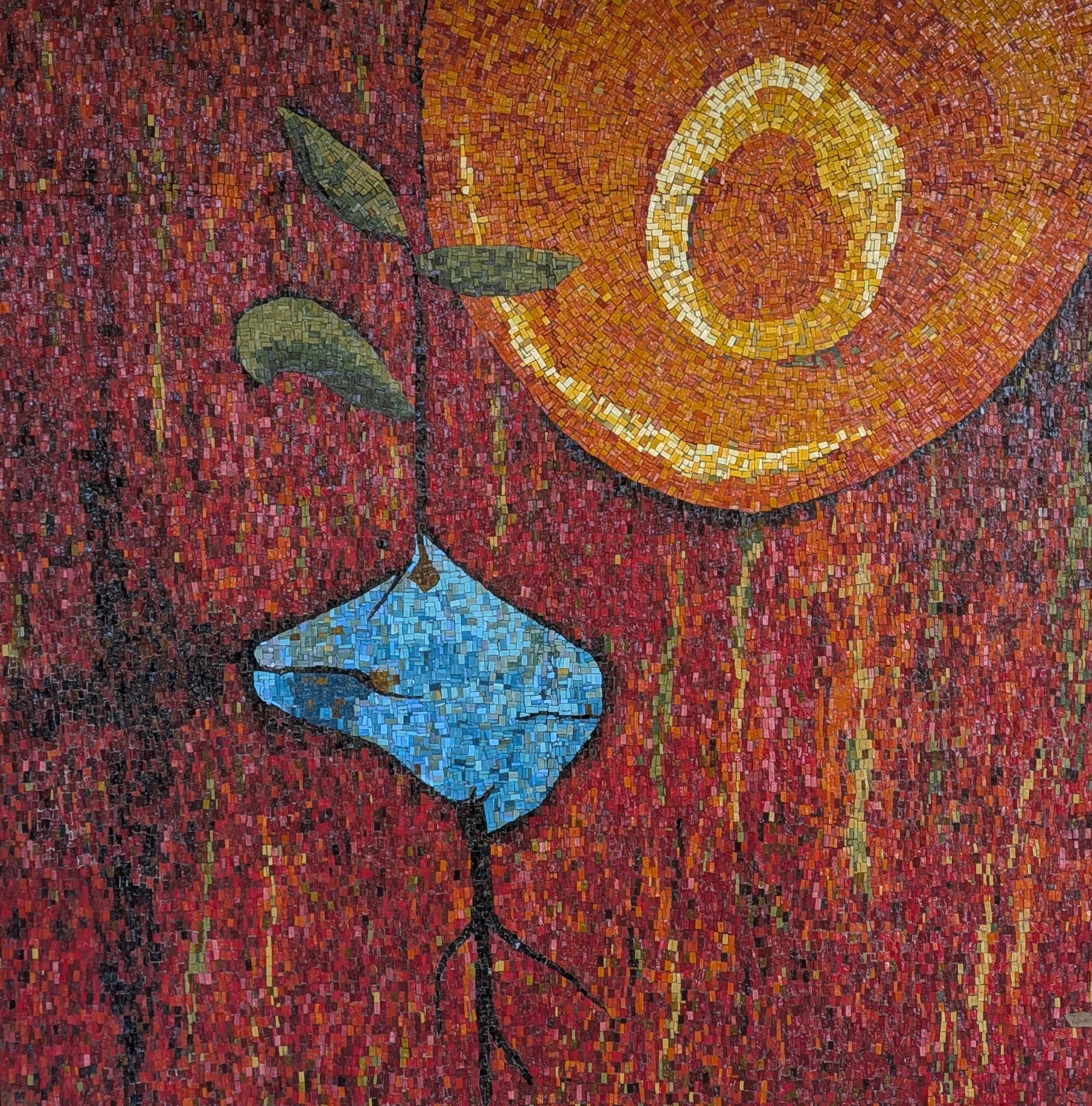
Karen Glanders’ Franciscan Values Informed by Prayer features five mosaics of abstracted imagery. Starting from the far left, the first panel depicts a leafy branch and a pure white bird facing away from the viewer against a creamy white speckled background. The second features the prow of a boat guided by a lighted torch against a mottled sage green background. The third panel illustrates a censer emanating smoke that drifts off to the viewer’s right against dappled dark blue. The fourth panel is dominated by a bowl from which water infinitely pours against a blue background. Finally, against a blazing red background, the fifth panel features a tree sprouting from a blue water-like object, its reflection (or a lifeless version) below, with a yellow-orange orb dominating the scene. Over the years these mosaics have been installed in this hallway, I have opted not to individually title them — I enjoy walking by and listening to students wonder about what the imagery represents and how it ties to Marian’s Franciscan values, reaching conclusions of their own.
If you have time, visit our second-floor Evans Center Art Gallery. This second-floor gallery includes works created by local, regional, and national visiting artists (acquired through our Talbot Street Visiting Artist Program) and our graduating seniors (acquired through our Senior Purchase Prize). To find it, enter from the east doors, turn the corner to your left, and use the elevator to make your way to the second floor. Walk from the elevator to the long hall in front of you. Take a moment to enjoy these other works — are there any interpretations you can draw from any of them related to reconciliation, or to our other Franciscan values of Dignity of the Individual, Peace & Justice, or Responsible Stewardship?
These five mosaics are intentionally untitled, representing the Franciscan values of Dignity of the Individual, Peace & Justice, Responsible Stewardship, and Reconciliation, all based in prayer. How do you see those values represented in the imagery — especially Reconciliation, since that is the focus of this walk?
Jamie Higgs, Ph.D. Associate Professor of Art History and Curator of the Marian University Permanent Art Collection
Thank you for walking with us.
Thank you for joining me on one of our Franciscan Values Art Walks | Art Talks. If you would like to take another walk, you can return to the Art Walks | Art Talks home page.
For more information about the Marian University Permanent Art Collection, contact Jamie Higgs, Ph.D., Associate Professor of Art History and Curator of the Marian University Permanent Art Collection at jhiggs@marian.edu or (317) 955-6432.