Welcome to Marian University's Associate in Applied Science in Occupational Therapy Assistant (OTA) program! If you're passionate about helping others, this is your chance to make a real difference. As an OTA, you'll work alongside occupational therapists to support people of all ages in overcoming challenges and gaining independence in their daily lives. Our program combines hands-on experience with engaging coursework, so you’ll graduate feeling confident and ready to jump into this rewarding career.
To be considered for admission to the Occupational Therapy Assistant (OTA) Program, applicants must:
Be admitted to Marian University
Have a minimum cumulative GPA of
High school students: 3.0 cumulative GPA.
Marian students with <12 credits: 3.0 cumulative GPA.
Marian students with ≥12 credits or transfer students with ≥12 credits: 2.8 cumulative GPA.
Science Requirement:
High school applicants: one high school lab science; if not completed, a college-level lab science (BIO 151, CHEM 101, PHY 101, or equivalent) with a grade of C or better prior to program start.
Transfer applicants: one college-level lab science with a grade of C or better.
Transfer of Anatomy & Physiology requires completion within the past five years.
Transfer credit from another Occupational Therapy Assistant program is not accepted. Students may transfer credits toward general education and co-requisites courses only.
Complete the OTA application
Participate in an interview, that you will select when completing the OTA application.
Submit your application through Marian University Undergraduate Admissions.
Step 2: Complete the OTA Application. Once admitted to Marian University, you will complete the OTA application, which includes:
Short written responses about your interest in becoming an Occupational Therapy Assistant
Step 3: Interview
Applicants will participate in a virtual interview (Approximately 45 minutes)
Conducted by three people on the OTA admissions committee
How Decisions Are Made
Selection is based on composite Interview and GPA score.
Applicants are notified of their admission status within a few weeks.
If You Are Accepted
If offered admission, you will be asked to complete the following required steps to confirm and secure your place in the program:
Submitting an enrollment deposit
Signing a letter of intent
Completing the required onboarding steps
Applications are reviewed on a rolling basis, and admission offers continue until the class is full
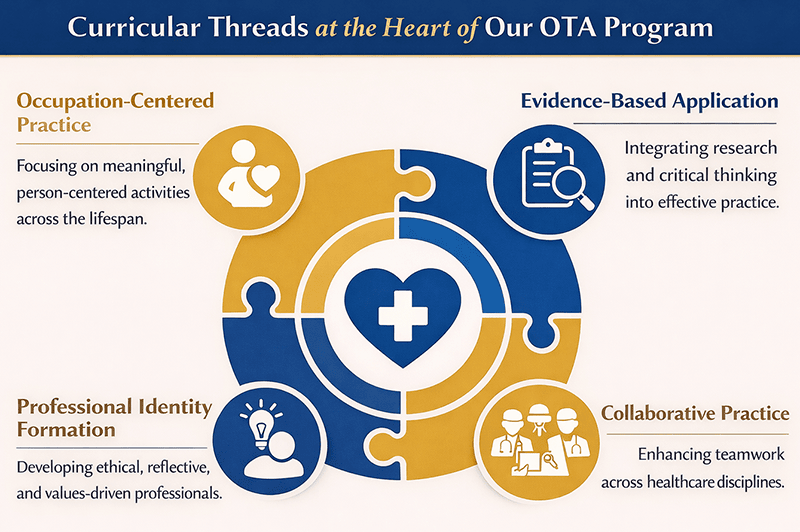
The Marian University Occupational Therapy Assistant (OTA) program curriculum is grounded in Franciscan values and guided by the Occupational Therapy Practice Framework (OTPF). It is thoughtfully designed to support students as they build knowledge, develop hands-on skills, and strengthen clinical reasoning in a progressive and meaningful way.
Each 16-week semester integrates co-requisite courses that complement OTA-specific content and establish a strong academic foundation. OTA courses are delivered in focused 8-week sessions, allowing students to fully engage with key concepts before advancing to new material.
Throughout the program, learning is reinforced through practical application. Each semester concludes with hands-on experiences in the classroom and an immersive Level I fieldwork, where students apply their knowledge and skills in real-world settings.
Achieve aSatisfactorygrade in OTA 306 Level IIB Fieldwork
Submit all required paperwork for the second level IIfieldwork OTA 306
Completion and grade of C or better in OTA 310 Professional Formation III
Completion of all Transformational Journey Courses- FSY 105, BIO 223, PSY 101, ENG 112, COM 101, PSY 205, THL 105
Cumulative GPA of 2.8 or higher.
Changing ofall incomplete grades to letter grades or achieving at least a grade of C at the registrar's office
Submission of evidence that Marian University considers the student has completed all the requirements. For example, the student has no unpaid parking tickets or library fines, or other university "holds."
Fieldwork Level II must be completed within18 monthsof completion of the didacticportionof the OTA program
Estimated Program Cost
The estimated total cost for completing the Associate of Applied Science - Occupational Therapy Assistant program is $32,368 (full-time tuition – 5 semesters) for the 2027-28 academic year. This includes books and supplies. Tuition may vary based on the number of credits a student is enrolled in and whether a student enters the AAS-OTA program with prior credits for general education/TJP requirements.
Identity Verification
Marian University uses a layered, multi-method approach to verify that the student who registers for a course or program is the same student who participates in and receives academic credit. Marian University does not assess any additional charges to students for the identity verification processes described in this standard. This policy is communicated to prospective and enrolled students through the OT Student Manual and course syllabi. Should any future identity verification tool requiring additional student cost be considered, the program will provide explicit advance notification to students at the time of registration or enrollment.
Mission
Our mission is to transform lives through skilled, heartfelt occupational therapy. Rooted in Franciscan values of dignity, service, and justice, Marian University's Occupational Therapy programs prepare practitioners to empower individuals to achieve meaningful participation through holistic, person-centered care. We cultivate professionals who honor human dignity and serve communities with ethical excellence and compassionate advocacy.
Vision
To exemplify leadership in occupational therapy education through innovation, community engagement, and interprofessional collaboration, preparing transformative practitioners who honor human dignity and advance meaningful occupation across all populations.
The Marian University Occupational Therapy Assistant (OTA) Program is grounded in the belief that participation in meaningful daily activities—occupations—is essential to health, well-being, and quality of life. In alignment with the American Occupational Therapy Association and the Occupational Therapy Practice Framework, the program prepares entry-level occupational therapy assistants to support individuals, families, and communities in achieving meaningful participation across the lifespan (AOTA, 2020)
Occupational therapy practice is occupation-centered, client-centered, and holistic. Students learn to consider the physical, cognitive, psychosocial, cultural, and environmental factors that influence a person’s ability to engage in meaningful activities. Graduates are prepared to implement evidence-based interventions under the supervision of an occupational therapist and contribute to habilitation, rehabilitation, health promotion, and prevention.
The OTA Program reflects the mission and Franciscan Catholic tradition of Marian University. Guided by the values of dignity, service, and justice, the program prepares students to provide compassionate, person-centered care that respects the inherent worth of every individual.
Students are encouraged to advocate for individuals and communities whose participation in meaningful activities may be limited by social, environmental, or systemic barriers. Through service, reflection, and ethical practice, graduates develop a commitment to promoting equity, occupational justice, and access to meaningful life participation.
Students enrolled in the Occupational Therapy Assistant program are required to participate in fieldwork experiences in order to successfully complete the program. Prior to participating in fieldwork experiences, all students are required to obtain and pay for a background check and any other mandatory screening processes. Upon completion, students are required to submit necessary documentation via the appropriate vendor, as identified by the department. The timeline for completion of the background checks and other screening processes will be articulated by the program.
Positive results from a criminal background check that are sufficiently severe in nature may result in the inability of a student to progress in the program and may result in dismissal. Examples of sufficiently severe offenses include, but are not limited to; violent felony convictions, convictions for crimes of deception, convictions for sex crimes, and placement on a sex offender registry. Any subsequent criminal arrests that occur after enrollment must be reported to the unit Dean, or designee.
When a student has a positive finding on a criminal background check, they are strongly encouraged to go through the NBCOT Early Determination process. The appropriate personnel on campus and at a fieldwork site will evaluate the information and surrounding circumstances to determine if the student can participate in a fieldwork experience. Although the University will make reasonable efforts to place admitted students in field experiences and internships, it will be up to the host facility to determine whether a student will be allowed to work at that facility. The occupational therapy program will take reasonable steps to find alternate placements, but a failure to place students as a result of a positive criminal background check may result in a student being unable to satisfy the graduation requirements of the program.
Even if allowed to progress in the program, students should be aware that a criminal record may jeopardize licensure by the State certification body. Students are advised to consult the appropriate certification body corresponding to their intended occupation for more details.
Successful completion of a program of study does not guarantee licensure, certification, or employment in the relevant occupation.
What will you study in Marian's OTA program?
Comprehensive Curriculum
The program offers a perfect blend of rigorous academic coursework and extensive hands-on experiences. Students will gain a deep understanding of human anatomy, psychology, and occupational therapy principles while developing practical skills essential for client care.
Fieldwork Partnerships
Benefit from our strong relationships with healthcare facilities across the region. These partnerships provide diverse fieldwork placement opportunities, allowing students to gain experience in various settings such as hospitals, rehabilitation centers, schools, and community organizations.
Career Opportunities
OTA graduates will be prepared to work in a variety of settings, making a tangible difference in people's lives every day.
Opportunity to Grow
Bridge OTA associate degree curriculum with undergraduate bachelors' majors.
Community Engagement
Participate in community outreach programs, applying skills while making a positive impact in local communities.
State-of-the-Art Facilities
Train in our cutting-edge simulation labs equipped with the latest technology and adaptive equipment used in the field. This hands-on experience ensures students are well-prepared for real-world scenarios.
Interprofessional Education
Collaborate with students from other healthcare programs, fostering the teamwork skills essential in modern healthcare environments. Marian University is home to the Woods College of Osteopathic Medicine, the Leighton School of Nursing, and programs in Occupational and Physical Therapy.
Experienced Faculty
Learn from passionate instructors who bring years of practice experience and academic expertise to the classroom. The faculty is dedicated to student success and provides personalized mentorship throughout a student's academic journey.
Embark on a fulfilling career path with Marian University's Occupational Therapy Assistant program. Join us in our mission to empower individuals, promote wellness, and enhance quality of life through the power of occupation-based interventions. The journey to becoming a vital part of the healthcare team starts here!
Accreditation Statement
The associate-degree-level occupational therapy assistant program has applied for accreditation and has been granted Candidacy Status by the Accreditation Council for Occupational Therapy Education (ACOTE) of the American Occupational Therapy Association (AOTA), located at 7501 Wisconsin Avenue, Suite 510E, Bethesda, MD 20814. ACOTE’s telephone number c/o AOTA is (301) 652-AOTA and its web address is www.acoteonline.org.
The program must have a preaccreditation review, complete an on-site evaluation, and be granted Accreditation Status before its graduates will be eligible to sit for the national certification examination for the occupational therapy assistant administered by the National Board for Certification in Occupational Therapy (NBCOT). After successful completion of this exam, the individual will be a Certified Occupational Therapy Assistant (COTA).
In addition, all states require licensure to practice; however, state licenses are usually based on the results of the NBCOT Certification Examination. Note that a felony conviction may affect a graduate’s ability to sit for the NBCOT certification examination or attain state licensure. Students must complete 16 weeks of Level II fieldwork within 18 months following the completion of the didactic portion of the program.
OTA Admission Info
(317) 955-6400 admissions@marian.edu
Program-Specific Info
Amanda Luper, MOT, OTR, CBIS Program Director and Professor (317) 955-6604 aluper@marian.edu