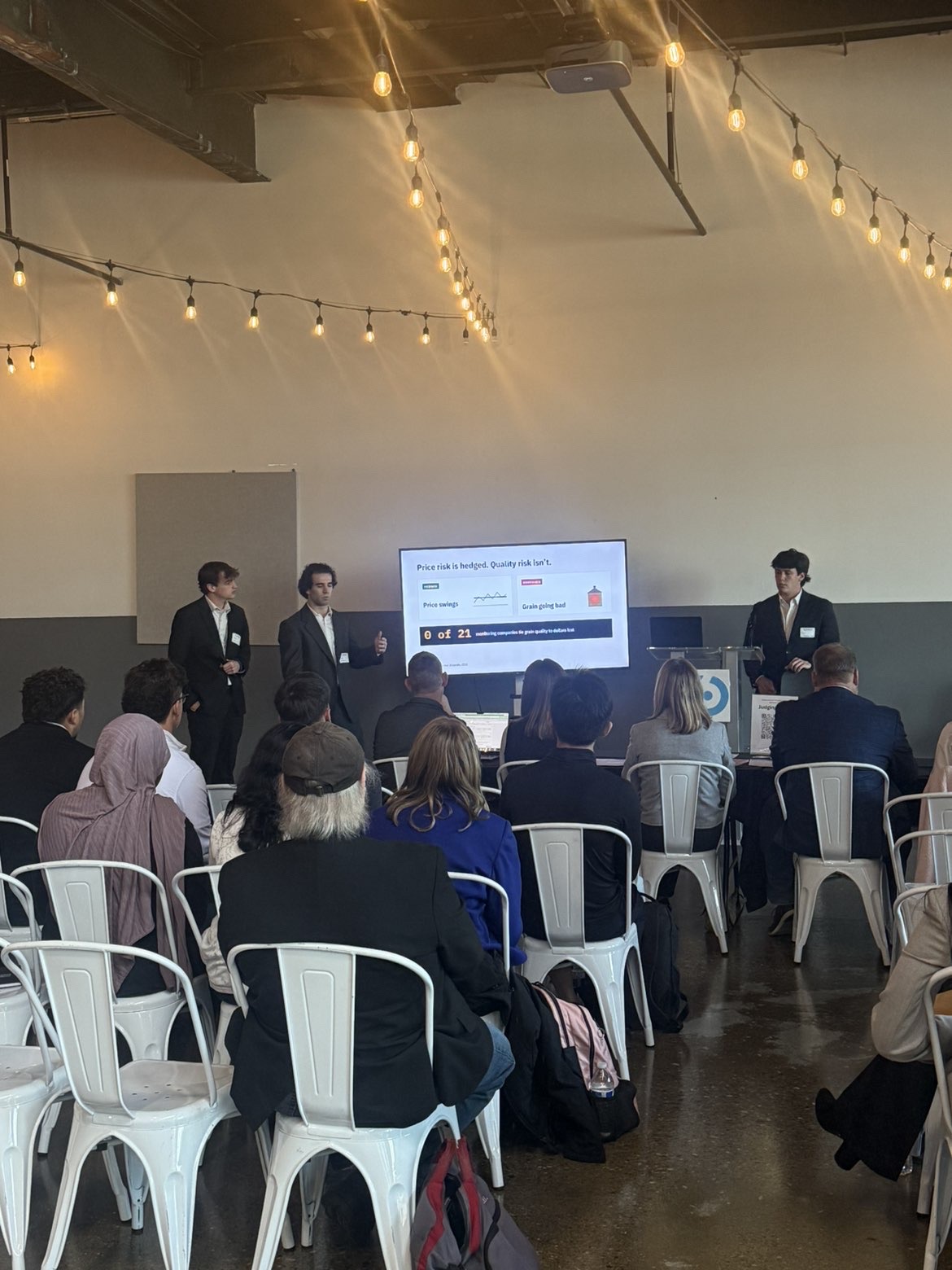
 Three Marian University seniors scrapped their original idea just four days before a statewide entrepreneurship competition and still finished third, earning $1,000. The Anchor & Accelerate Pitch Competition was part of the second Intercollegiate Entrepreneurs Summit, held Friday, November 6, 2026, at the 16 Tech Innovation District in Indianapolis.
Will Hemmerling, Peter Waning, and Zachary Wilson, all School of Business seniors, competed against 39 other teams among more than 100 students from 11 universities, including Purdue, Notre Dame, Indiana University, and Butler.
Their first concept was software to combat real estate title fraud. After talking with experienced real estate professionals, the team concluded it wasn’t the right problem and changed course Monday evening.
The new direction came from Wilson, who spent the summer at Commodity & Ingredient Hedging in Chicago and had seen how quickly declining grain quality turns into lost money.
The result was BinBook, a proposed platform that works with the grain-bin sensors and accounting software farmers and cooperatives already use. Drawing on published university research on grain storage, it would estimate how long a crop can be stored safely, calculate the financial exposure, and indicate when selling or shipping makes the most sense. Instead of only flagging changes in moisture or temperature, BinBook would translate them into dollars at risk.
Wilson led the technical work, using Claude Code, an AI coding tool, to build a working demonstration for the judges.
“I learned that I could confidently display skills that are practiced in the classroom, and apply them to real-world problems, in front of an audience,” Wilson said.
Waning opened and closed the four-minute pitch, and Hemmerling led marketing and communications, shaping the team’s research into a business case.
“Finishing third hurt. We put in countless hours, and we wanted first place,” Hemmerling said. “We learned that more preparation and reps would have helped us in the long run, but we are proud to have represented Marian University at such a high level.”
The team built BinBook for the competition and doesn’t currently plan to commercialize it. Hemmerling, co-founder and president of Marian’s Entrepreneurship Club, said the experience showed how much the classroom had prepared them.