From business analytics to nursing and medicine, faculty are using artificial intelligence to support students while keeping human judgment at the heart of education.

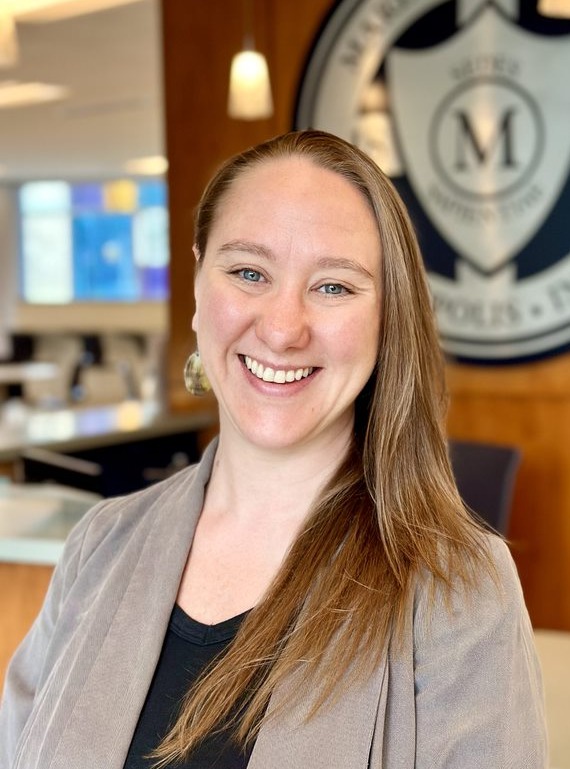

When students in Bonnie Garrity's upper-level business analytics course need help understanding a difficult concept, they no longer have to wait until the next class or office hours.
They can ask Issi.
The AI-powered tutoring application, developed by Garrity, an assistant professor of business analytics at Marian University, is available around the clock through the university's Canvas learning platform. It answers questions using course-specific information and helps students work through challenging material.
But Issi does more than assist students. It also helps Garrity become a more responsive instructor.
By reviewing anonymized student interactions, Garrity can identify concepts students are struggling with and adjust her teaching materials accordingly. She has already added resources to Canvas based on information gathered through the application.
"What excites me most is the feedback loop: student questions show me what to improve for the next class," Garrity said. "My advice to other educators is to start with a real problem in your course, not the technology."
Garrity is among the Marian University faculty exploring how artificial intelligence can improve teaching and learning while helping students develop the judgment needed to use the technology responsibly.
Through a faculty course-redesign initiative, instructors across disciplines are developing practical approaches that emphasize critical thinking, academic integrity, and responsible use of emerging technology.
A Tutor That Helps Students Think
Garrity developed Issi to address a particular challenge in upper-level analytics courses: the absence of peer tutors and teaching assistants. Students qualified to provide that support have often already graduated.
Issi, short for Isidore Insights, helps fill that gap.
Embedded in Garrity's AIM323 course, the application provides students with access to explanations of course concepts, instructor notes, schedules, and assignments. Garrity plans to expand its use to AIM423 in the spring.
Rather than simply providing answers, Issi uses the Socratic method to guide students toward understanding.
Students interact through anonymous aliases, while Garrity reviews anonymized conversations to identify recurring questions and learning challenges.
Students have begun telling Garrity, without being prompted, that Issi has helped them.
The application's name also reflects Marian's Catholic identity. It honors St. Isidore of Seville, an early scholar and compiler of encyclopedic knowledge, widely associated with the patronage of the internet and computer programmers.
Preparing Nurses to Think Critically
At Marian University's Leighton School of Nursing, Assistant Professor Amy K. Phemister, MSN, RN, CPN, has introduced a similar resource in her senior-level nursing leadership and management course.
Her AI teaching assistant, Alice, serves as a study companion that students can consult when they encounter difficult concepts, need to review material, or want to test their knowledge.
Unlike general-purpose AI search tools, Alice draws from course resources selected and reviewed by Phemister rather than searching the open web.
Alice also uses the Socratic method, encouraging students to work through questions rather than simply receiving answers.
That distinction matters especially in nursing, where evaluating information and making sound clinical decisions are essential.
Phemister introduced Alice this fall and has received generally positive initial feedback. She is gathering additional student feedback to better understand how the tool is being used.
Her broader goal is to help future nurses recognize both the possibilities and the limitations of artificial intelligence.
"AI isn't going away, and students are going to use it. Our responsibility as educators is to help them use it thoughtfully while developing the critical thinking and clinical judgment they'll need as nurses," Phemister said.
For Phemister, the central challenge is teaching students to use AI as a resource without allowing it to replace their knowledge, reasoning, or professional judgment.
Teaching Future Healthcare Professionals to Question AI
While Garrity and Phemister have developed AI assistants for individual courses, Erica Ausel, Ph.D., Associate Professor of Anatomy and Biomedical Science Master's Program, is taking a broader approach.
Ausel developed AI COMpass, a pilot educational series designed to help medical and biomedical science master's students understand how artificial intelligence works, evaluate its limitations, and consider its role in healthcare.
The five-part series addresses AI fundamentals, studying with AI, ethics, critical thinking, and applications in healthcare. Optional sessions explore its use in research and writing.
Through short lectures, hands-on activities, and discussions, students examine questions that go beyond whether AI can produce an answer.
They consider whether that answer is reliable, how the technology might influence their decisions, and what responsibilities healthcare professionals retain when using it.
"Students are using AI, but that does not mean all are using it well, effectively, or ethically," Ausel said.
Ausel connects the instruction to the osteopathic approach to caring for the whole person: mind, body, and spirit.
Medical knowledge enables healthcare professionals to evaluate information critically. Clinical decisions remain the provider's responsibility. AI can affect the personal connection and trust between patients and their caregivers.
AI COMpass is underway, with three of its five sessions and one focused session expected to be completed by the end of the fall semester. Ausel is gathering student feedback to help shape the program, including sessions under development for spring 2027.
"I support a cautious approach to AI, but I remain optimistic," Ausel said.
Keeping Education Human
Although their projects serve different disciplines and learning needs, Garrity, Phemister, and Ausel share a common objective: helping students use artificial intelligence thoughtfully rather than depend on it uncritically.
Their approaches also highlight an important distinction in the university's exploration of emerging technology. AI can make learning resources more accessible, help faculty respond to student needs, and introduce students to tools they may encounter in their careers. But it does not replace an instructor's expertise or a student's responsibility to think critically.
For Marian faculty, the opportunity is not simply to bring AI into the classroom. It is to teach students how to use it wisely, question its conclusions, and carry those habits of judgment into their professional lives.